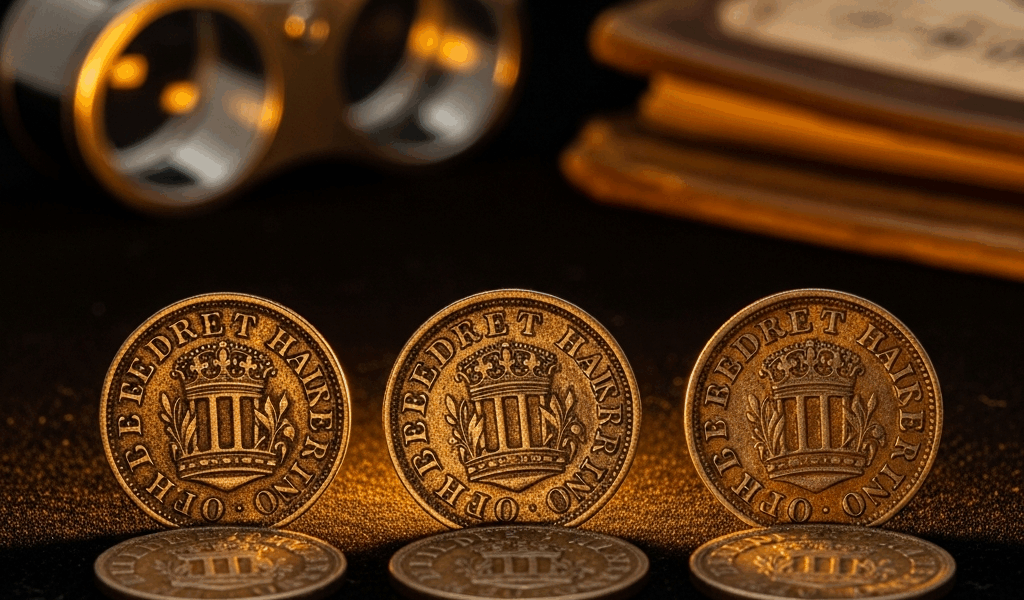
Half Penny Coins — History, Value, and What Yours Might Be Worth
Half penny coin values have gotten complicated with all the misinformation flying around online. As someone who’s been digging through British and American copper coinage for about twelve years, I learned everything there is to know about halfpennies the hard way — starting with the afternoon I cracked open a biscuit tin from my grandfather’s estate and stared blankly at maybe 200 coins I couldn’t identify. Some were halfpennies. Most were worth almost nothing. A few were not. Today, I will share it all with you — because that gap between “almost nothing” and “not” is exactly where casual sellers leave real money on the table.
A Brief History of the Half Penny
The halfpenny has a longer run than most people realize. We’re talking three centuries, multiple continents, and enough monetary drama to fill a decent-sized book. Understanding that timeline matters when you’re trying to figure out what you’re actually holding.
The British Halfpenny — 1672 to 1984
England had been issuing halfpennies in silver and later tin going back to medieval times. But the modern copper halfpenny really kicks off in 1672 under Charles II — that’s when the Royal Mint started producing something consistent enough that ordinary people could actually rely on it. Before that? Local merchants were striking their own halfpenny tokens out of sheer desperation. The official coinage supply was genuinely that unreliable.
The coin ran through every major monarch from Charles II straight through to Elizabeth II. George III halfpennies are probably the most commonly encountered today — his reign ran from 1760 to 1820, which is a long time to mint coins. The 1799 Soho Mint issues from Matthew Boulton’s Birmingham operation are a particular favorite among collectors. More on those shortly.
Britain finally retired the halfpenny in 1984. The math had stopped working — production costs exceeded face value, and inflation had ground its purchasing power down to essentially nothing. Decimalisation in 1971 had already killed the old pre-decimal halfpenny, so technically there were two distinct British series: the pre-decimal coins and the short-lived decimal halfpenny that limped along from 1971 until its quiet exit in 1984.
The American Half Cent — 1793 to 1857
The United States issued its own version called the half cent, running from 1793 through 1857. Not technically “halfpennies” in name — but collectors group them together because they served identical functions and attract identical buyers. That’s what makes the category endearing to us copper enthusiasts.
The half cent was the smallest denomination America ever produced. Congress authorized it under the Coinage Act of 1792. Production was sporadic — there are entire years with zero half cents struck — which is a big part of why certain dates command serious premiums. Discontinued in 1857 for the same reason the British halfpenny eventually disappeared: it had become practically useless in everyday commerce.
Colonial Halfpennies
Before the United States existed, the American colonies circulated British halfpennies, Irish halfpennies, and a patchwork of locally issued copper tokens. The Machin’s Mills halfpennies from New York — struck between roughly 1786 and 1789 — are a particularly interesting category. Crude, unofficial, and now quite collectible. Ireland also had its own distinct halfpenny series that circulated through the colonies and gets routinely confused with British issues by newer collectors. Worth knowing the difference before you start making assumptions.
Why They Were Discontinued
Frustrated by the rising cost of copper production and a coin that couldn’t buy anything meaningful, every government running a halfpenny program eventually reached the same conclusion. Britain, the U.S., Australia, Canada — all pulled the plug at different points in the twentieth century. The Irish halfpenny disappeared in 1986. Australia dropped theirs in 1966. None of it was sentimental. This new idea of eliminating low-denomination coins took off during the mid-twentieth century and eventually evolved into the discontinued-denomination landscape collectors navigate today.
What Your Half Penny Is Actually Worth
Probably should have opened with this section, honestly. Most people reading this have coins in their hands right now, not a casual academic interest in monetary history. So here’s the practical answer.
Common Dates — The Honest Truth
The majority of British halfpennies you’ll encounter — George V issues from 1911 to 1936, most George VI coins, the standard Elizabeth II pre-decimal pieces — land somewhere between two pence and maybe fifty pence in circulated condition. In American terms, roughly five to sixty cents. They’re copper, they’re common, and there are millions of them floating around. I’ve bought bags of 200 mixed Victorian and Edwardian halfpennies on eBay for around £8 total. Nobody’s getting rich on these.
The decimal halfpenny — 1971 through 1984 — is essentially face value unless you have a proof or a specific scarce year. The 1984 issue gets a small premium in uncirculated condition, around £2 to £5, because it’s the final year. That’s about it.
Condition Grading Basics
Copper coins are brutal to grade. They corrode, they tone unevenly, and they show wear faster than silver ever does. The standard scale runs from Poor (P-1) through Perfect Mint State (MS-70). For halfpennies, most collectors work within a practical range:
- Good (G-4) — Major design visible, heavy wear. Common date value applies.
- Very Fine (VF-20 to VF-35) — Moderate wear, all details clear. Where most “nice-looking” coins actually land.
- Extremely Fine (EF-40 to EF-45) — Light wear on high points only. Worth a meaningful premium on key dates.
- Uncirculated (MS-60 and above) — No wear whatsoever. Copper coins in this grade are genuinely rare. The Red (RD) designation for full original color adds significant premium on top of that.
I’m apparently terrible at self-grading copper, and PCGS works for me while my own assessments never seem to hold up. Sent in a George III halfpenny I was convinced was Extremely Fine — paid $30 in grading fees — and it came back VF-30. Don’t make my mistake. Be conservative before spending money on professional grading.
Key Dates and Approximate Values
These are ballpark figures pulled from recent auction results and current dealer pricing. Condition matters enormously here — a Fine example can be worth ten times a Good example on key dates:
- 1672 Charles II halfpenny — £40 to £200+ depending on condition
- 1694 William and Mary halfpenny — £60 to £300+ in nicer grades
- 1733 George II halfpenny — Common, £5 to £30
- 1799 Soho Mint halfpenny — £15 to £150 for choice examples
- 1844 Victorian halfpenny — £10 to £80 in EF
- 1793 U.S. half cent (Liberty Cap) — $500 to several thousand dollars
- 1796 U.S. half cent — $1,000 to $10,000+ — a genuine key date
- 1831 U.S. half cent — $50 to $400 depending on variety
Which Half Pennies Collectors Want
There’s collecting halfpennies, and then there’s collecting halfpennies. The serious numismatists chasing these coins are after specific issues, varieties, and mint qualities that casual sellers almost never identify correctly. So, without further ado, let’s dive in.
The 1694 William and Mary
Struck during the brief joint reign of William III and Mary II, the 1694 halfpenny features both monarchs facing each other on the obverse — one of the more visually striking British coins of the era. Nice examples in VF or better are genuinely scarce. A well-preserved specimen with original surfaces sold at a DNW auction in 2021 for £280. Not fortune-changing money. But it’s not nothing, either.
The 1799 Soho Mint Issues
Frustrated by the inconsistency of Royal Mint output, Matthew Boulton produced his 1799 halfpenny at the Soho Manufactory in Birmingham using steam-powered presses — a genuine technological leap at the time. The coins are sharper and more consistent than anything the Royal Mint was managing. Collectors love them for exactly that reason. A specimen-quality example with full original red-brown surfaces fetches £100 to £200 without much effort. Proof strikes from this same period go considerably higher.
The 1793 American Half Cent
The first year of issue for the American half cent. The 1793 Liberty Cap — struck in Philadelphia, identifiable by the Liberty Cap design with the head facing left, a design changed the following year — is a coin that serious U.S. collectors actively compete over. Even a heavily worn example in Good condition starts around $500. Problem-free mid-grade examples regularly clear $2,000 at Heritage Auctions or Stack’s Bowers. That was 1793. These coins have had over two centuries to disappear, and most of them did.
Varieties and Errors That Add Value
Both British and American halfpennies exist in numerous die varieties — and only specialists care about them, but those specialists care enormously. The Sheldon variety numbers for U.S. half cents (C-1, C-2, and so on) can mean the difference between a $100 coin and a $1,000 coin from the exact same year. On the British side, collectors chase obverse and reverse die pairings documented in reference works like Peck’s British Museum Catalogue.
So-called “mule” varieties — coins struck from mismatched die combinations — turn up occasionally and command significant premiums. Overdates, where one date was punched directly over a previous year, appear across several American half cent series. Worth researching carefully if you’re holding early U.S. copper.
How to Sell Half Pennies
The selling strategy depends almost entirely on what you have. Two categories. Common coins and everything else.
Common Halfpennies — Realistic Expectations
George V, George VI, and standard Elizabeth II halfpennies in circulated grades? Sell them in bulk. List a lot of 50 or 100 on eBay for a few pounds and move on. Individual listings for 20p coins don’t make economic sense — the platform fees eat whatever profit exists. I’ve sold bulk lots of 100 Victorian copper for £12 to £18 total. Not exciting. But it clears the tin.
Coin fairs work too — at least if you want cash in hand immediately and no shipping hassle. Dealers will offer wholesale, usually 30 to 50 percent of retail, but the transaction is over in sixty seconds.
Key Dates — Get Them Graded First
If you think you have a key date — anything flagged on the list above, or something a reference book marks as scarce — get it professionally graded before you list it anywhere. PCGS and NGC both handle world coins, not just American issues. A PCGS-graded 1694 William and Mary halfpenny in VF-35 will sell for meaningfully more than a raw example. Buyers trust the holder. They don’t trust your assessment, and frankly, they probably shouldn’t trust mine either.
For American half cents specifically, raw coins at auction routinely underperform — bidders discount for the possibility of cleaning or hidden damage. A graded coin removes that uncertainty entirely.
Where to Sell Based on What You Have
- eBay — Best for common coins, bulk lots, and mid-range pieces where a large enough audience exists to find your buyer
- Heritage Auctions or Stack’s Bowers — Right venue for American half cents worth $200 or more, especially key dates
- DNW (Dix Noonan Webb) or Spink — The London auction houses for any British halfpenny of genuine significance
- Coin dealers — Fast and convenient, but expect 40 to 60 percent of retail value in return
- Specialist collector forums — The British Numismatic Society and Early American Coppers club both run active trading communities where serious buyers actually congregate
The half penny is a small coin with a long story. Most examples turning up in old jam jars and inherited biscuit tins are common, worn, and worth a handful of pence — if that. But what is a genuinely rare halfpenny? In essence, it’s an early date, a pristine survivor, or a documented variety that specialists have been chasing for decades. But it’s much more than that — it’s a coin that serious buyers will compete hard to own. Knowing which category you’re holding is everything.

Stay in the loop
Get the latest numisma master updates delivered to your inbox.