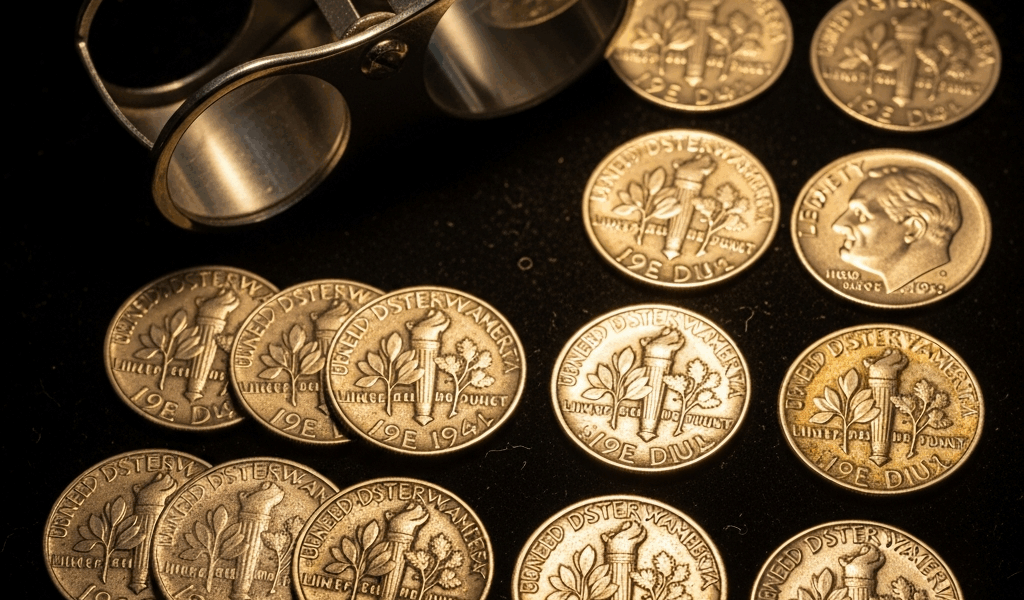
Why Roosevelt Dimes Deserve More Than a Glance
Roosevelt dime value by year and mint mark has gotten complicated with all the misinformation flying around. You find a dime in your change, maybe squint at the date, and toss it back in your pocket. That was me — every single time — for probably a decade.
Here’s the thing that changes everything: from 1946 through 1964, the U.S. Mint struck Roosevelt dimes in 90% silver. Then 1965 arrived and the composition flipped to copper-nickel clad. That silver content alone pushes pre-1965 dimes above face value — sometimes way above. Certain dates and mint marks hit $20, $50, even $100+ depending on what condition they’re in.
The frustrating part? Most value guides treat Roosevelt dimes like footnotes. They’re not dramatic like Morgan dollars. Not exotic like early large cents. But for collectors working with a realistic budget, they’re genuinely worth hunting. And if you’ve got a coffee can full of old change somewhere, you might be sitting on real money without knowing it.
Silver Roosevelt Dimes Worth Knowing — 1946 to 1964
The 1949 and 1949-S are where I first started paying attention. Searched by condition, these two consistently outrun everything around them date-wise. The 1949 — no mint mark — trades around $3 in circulated Good condition, climbs to $8–12 in Fine, and jumps hard to $40+ at Mint State 65. The 1949-S is more dramatic: circulated examples sit at $4–6, but a raw MS65 specimen hits $60–80.
Lower mintage years, plain and simple. The 1949 Philadelphia saw 26.1 million pieces struck. The 1949-S? Only 13.5 million. That sounds like plenty — until you remember how many dimes got spent, melted, or lost across 75+ years. Survivors in uncirculated condition become genuinely scarce. That’s what makes these dates endearing to us collectors.
The 1950-S is another standout — just 20.4 million minted. Circulated examples run $2–4, Fine condition gets you $6–10, and MS65 clears $50 consistently. I once pulled a raw 1950-S from an old bank roll at a flea market. Brilliant white coin, full luster, looked untouched. Sent it off to PCGS — this was around 2019, submission fee was $35 at the time — and it came back MS64. Sold it for $45 net. Barely broke even, honestly. But the education was worth every penny.
The 1951-S follows the same basic story. Lower survival rate in uncirculated condition equals higher premiums across the board. Figure $3–5 circulated, $8–15 in Fine, and $45–70 at MS65.
Now — the 1955 and 1955-S. These are what I’d call the common-date trap. High mintage numbers — 12.4 million for the 1955, 13.9 million for the 1955-S — mean circulated examples are everywhere and cheap, like $0.50–$1 each. But uncirculated specimens are a different conversation entirely. A raw MS65 1955 sits at $25–35. The 1955-S in MS65 pushes $40–50. Finding any dime that old in genuinely perfect condition is harder than most people expect. That’s the twist nobody mentions.
Proof sets deserve a mention here too. An original 1955 Proof set — still sealed, original packaging intact — carries a premium entirely separate from individual coin values. Mid-1950s uncirculated and proof Roosevelt dimes have become popular with type collectors who want a solid representative example without chasing a genuine rarity.
| Year | Mint Mark | Circulated (VG–Fine) | Uncirculated (MS60–MS64) | Gem (MS65+) |
|---|---|---|---|---|
| 1949 | None | $3–$5 | $15–$25 | $40–$65 |
| 1949 | S | $4–$6 | $25–$40 | $60–$90 |
| 1950 | S | $2–$4 | $15–$25 | $50–$75 |
| 1951 | S | $3–$5 | $20–$30 | $45–$70 |
| 1955 | None | $0.50–$0.75 | $10–$18 | $25–$40 |
| 1955 | S | $0.50–$1.00 | $12–$20 | $40–$60 |
Values in this table reflect market conditions as of early 2024, using PCGS CoinFacts and active dealer listings as reference. Silver spot price and collector demand both move these numbers. High-grade pieces — MS65 and above — carry serious premiums. They’re genuinely rare in that condition, full stop.
Key Date Clad Dimes That Surprise Collectors
Probably should have opened with this section, honestly — it would save a lot of people wasted time. Most Roosevelt dimes struck after 1965 are worth exactly ten cents. The copper-nickel clad composition is abundant. Mintages are enormous. Survival rates are excellent. A 1970-D or a 1985-P isn’t building anyone’s retirement fund.
The 1982 no-mintmark error dime is the exception worth knowing. Some dimes from early 1982 were struck at Philadelphia without a mint mark — an oversight during a transitional production period. These aren’t rare in absolute terms. Thousands exist. But they’re scarce enough relative to normal 1982 issues that collectors pay a consistent premium.
Circulated examples trade at $0.15–$0.25 depending on wear. Raw Mint State 63–64 coins run $3–6. Certified MS65 examples push toward $8–12. I’m apparently the type of person who held onto a raw MS65 example for five years before really digging into what it was worth — turns out I’d overpaid by about $2 off a poorly researched eBay listing. Don’t make my mistake. Check PCGS before you buy anything labeled “error.”
The 1996-W is another coin beginners bring up constantly. Struck at the West Point Mint exclusively for that year’s uncirculated mint set — it was never meant to circulate. Spotting one in the wild means somebody cracked open a mint set years ago and spent it. Raw uncirculated examples trade at $3–8 depending on eye appeal and remaining luster. Not a fortune, but a genuine reason to look twice at a 1990s dime before spending it.
How Condition and Grade Change Everything
Condition is everything. Take a single 1949 dime and walk it through the grade scale. Good — heavy wear, date readable, major details mostly gone — lands at $2–3. Very Good with slightly cleaner detail gets $3–4. Fine grade, visible design elements, moderate wear? $5–8. Very Fine with sharp details and only light wear? $12–18. Extremely Fine with nearly full luster and just a whisper of friction? $25–35. Fully uncirculated with original luster intact? $40–65 depending on the exact grade.
Same coin. Ten cents face value. Up to $65. That’s a 650x multiplier — and it exists because collectors actively compete for high-grade examples that are genuinely hard to find.
Assessing condition yourself starts with the torch on the reverse. Those vertical lines should be sharp and clearly separated. On the obverse, check Roosevelt’s hair detail above his right ear — wear hits high points first, so if that hair is smooth and flat, you’re looking at circulated, VG or Fine at best. Sharp and well-defined means Very Fine or better.
Check the rim all the way around — it should be crisp, not mushy. Bag marks and minor contact nicks on uncirculated coins are normal — mint bags aren’t gentle — but they push coins away from gem status. Deep-mirror fields with minimal distracting marks suggest high grades. Visible scratches, obvious cleaning, or physical damage knock value down hard. Cleaned coins, specifically, are worth a fraction of their natural counterparts. Collectors hate them.
Be honest with yourself here. I’ve watched sellers on eBay list clearly circulated coins as “Mint State” more times than I can count. The reverse happens too, though rarely. If you’re serious about knowing actual value — not optimistic guessing — grading services exist for exactly this reason.
What to Do If You Think You Have a Valuable Dime
First, confirm the date and mint mark clearly. Roosevelt dimes use large, easy-to-read dates on the obverse. The mint mark sits on the reverse, below the torch — small, but visible under a basic 5x loupe. Write both down. Then cross-reference against a key date list. Any 1949-S, 1950-S, 1951-S, or high-grade 1955 is worth pursuing further.
Next, assess condition honestly — at least if you want an accurate number rather than a pleasant surprise that turns into a disappointment. Bright light, a loupe if you have one, and a willingness to be strict. Are you actually seeing full luster and sharp design details, or are you talking yourself into Mint State on a coin that spent fifteen years in a pocket?
Common date, circulated condition? Probably $0.50–$2. Keep it for a date set if you’re building one. Submitting it for grading makes zero financial sense.
Key date, uncirculated condition? Pull up PCGS CoinFacts or NGC’s online price guide — both are free, both update regularly with real market data. You’ll find MS64 and MS65 pricing for essentially every Roosevelt dime ever struck. Five minutes of research tells you whether grading submission pencils out financially.
Grading fees run $25–$35 minimum per coin — PCGS Economy tier was around $30 last I checked — with turnaround measured in weeks. A 1955 dime that grades MS63 and books at $18 means you’ve lost money on the submission alone. That same coin grading MS65 at $40 means the fee was absolutely worth paying. Run the numbers before you mail anything.
For storage, use cotton gloves — at least if you want to avoid fingerprint oils accelerating toning. A 2×2 mylar flip or archival-grade holder works perfectly for most coins. Avoid anything PVC-based — those plastics leach chemicals that permanently damage surfaces over time. Cool, dry, dark storage keeps everything stable. None of this is expensive, and the habits matter.
Roosevelt dimes won’t make you rich. But checking dates and mint marks takes maybe three minutes per handful of coins. Genuine key dates turn up in old bank rolls, inherited collections, and $5 junk bins at coin shows more often than you’d think. A cup of coffee costs more than the effort — and costs a lot less than walking past a 1949-S because you didn’t bother to look.

Stay in the loop
Get the latest numisma master updates delivered to your inbox.