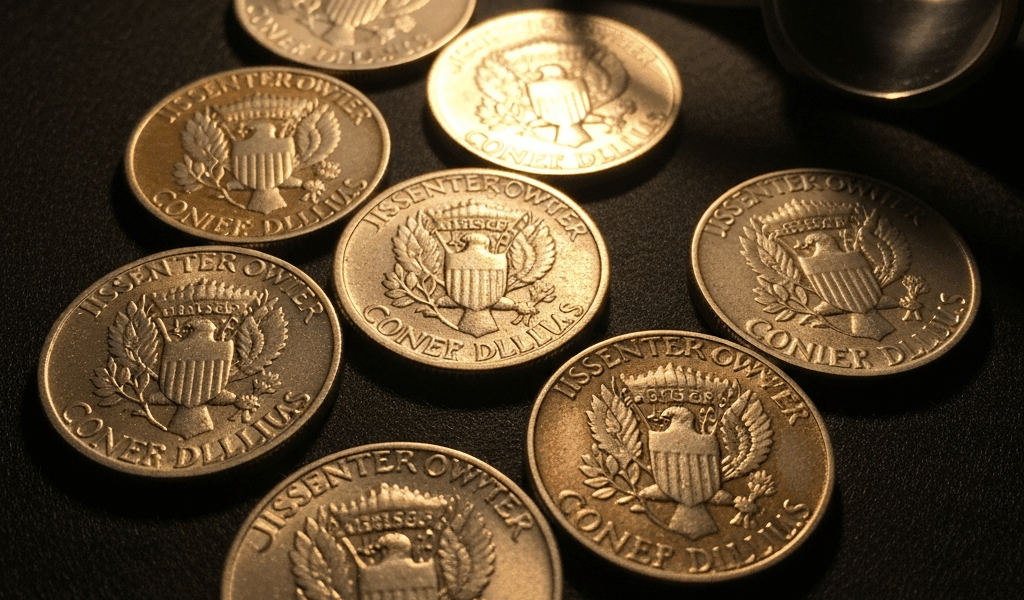
What Makes an Eisenhower Dollar Valuable
Eisenhower dollar values have gotten complicated with all the misinformation flying around at estate sales, flea markets, and coin show tables. As someone who’s spent the better part of five years cataloging coins at local shows and cross-referencing NGC and PCGS auction data, I learned everything there is to know about eisenhower dollar value by year and mint mark. Today, I will share it all with you.
Most people dig an Ike dollar out of a change jar and assume they’ve found something special. The reality? Most circulated specimens trade for $1 to $2. Barely above face value. That’s it.
But what is an Eisenhower dollar’s true value potential? In essence, it’s whatever the mint mark, silver content, and condition grade say it is. But it’s much more than that — a handful of specific dates and varieties can push that same coin to $20, $50, or well past $100.
Three things decide everything: the mint mark (P for Philadelphia, D for Denver, S for San Francisco), the composition (copper-nickel clad versus 40% silver), and the strike grade (circulated, uncirculated, or proof). Most casual sellers overlook this breakdown entirely. Probably explains why Ike dollars get misgraded or underpriced at estate sales with almost embarrassing regularity.
Circulated clad coins from Philadelphia and Denver? Expect $1 to $2. Uncirculated clad pieces climb to $3 to $8. Silver S-mint proofs and uncirculated silver examples jump into the $15 to $100 range — depending on year and strike quality. Key date varieties like the 1972-P Type 2 reverse and the 1976-S Bicentennial silver proof command premiums that casual sellers leave on the table constantly.
Eisenhower Dollar Value Chart by Year and Mint Mark
I built this table after cross-referencing dealer pricing, recent eBay sold listings, and NGC/PCGS auction results. Ranges reflect typical 2024 market values, accounting for normal wear and strike variation.
| Year | Mint Mark | Composition | Circulated Value | Uncirculated Value | Notes |
|---|---|---|---|---|---|
| 1971 | P | Clad | $1–$2 | $3–$6 | Common date |
| 1971 | D | Clad | $1–$2 | $3–$6 | Common date |
| 1971 | S | 40% Silver | $8–$12 | $15–$28 | Silver content drives base value |
| 1972 | P | Clad | $1–$2 | $4–$10 | Type 2 reverse has premium |
| 1972 | D | Clad | $1–$2 | $3–$7 | Common date |
| 1972 | S | 40% Silver | $9–$13 | $16–$32 | Silver content plus collector demand |
| 1973 | P | Clad | $1–$3 | $5–$12 | Lower mintage, slight premium |
| 1973 | D | Clad | $1–$2 | $4–$10 | Lower mintage than most years |
| 1973 | S | 40% Silver | $10–$14 | $18–$35 | Popular with silver stackers |
| 1974 | P | Clad | $1–$2 | $3–$8 | Common date |
| 1974 | D | Clad | $1–$2 | $3–$7 | Common date |
| 1974 | S | 40% Silver | $8–$12 | $14–$28 | Final year of regular issue silver |
| 1975 | P | Clad | $1–$2 | $3–$8 | No mint mark, common |
| 1975 | D | Clad | $1–$2 | $3–$7 | Common date |
| 1976 | P | Clad | $1–$2 | $4–$10 | Bicentennial reverse, Type 1 or 2 |
| 1976 | D | Clad | $1–$2 | $4–$10 | Bicentennial reverse, Type 1 or 2 |
| 1976 | S | 40% Silver | $12–$18 | $22–$55 | Bicentennial proof, highest collector demand |
| 1977 | P | Clad | $1–$2 | $3–$7 | Common date |
| 1977 | D | Clad | $1–$2 | $3–$7 | Common date |
| 1978 | P | Clad | $1–$2 | $3–$8 | Final year of issue |
| 1978 | D | Clad | $1–$2 | $3–$8 | Final year of issue |
Silver Eisenhower Dollars Are Worth More — Here Is Why
Probably should have opened with this section, honestly. The San Francisco Mint struck 40% silver collector versions from 1971 through 1974, then returned for the 1976 Bicentennial. Millions were produced and sold directly to collectors — so they aren’t rare in any dramatic sense. But they’re still worth real money, and the reasons are pretty specific.
Start by identifying them. That S mint mark on the obverse tells you San Francisco. Not enough on its own, though. Grab a digital scale — something like an American Weigh Scales LB-501 or any kitchen scale accurate to 0.1 grams. Clad Ike dollars weigh exactly 22.68 grams. Silver versions come in at 24.59 grams. That’s a difference you can actually feel once you’ve held both types back to back.
I’m apparently a tactile sorter and weighing works for me while eyeballing mint marks alone never does. The weight test has saved me from misidentifying coins more times than I’d like to admit.
At current silver prices — roughly $25 to $30 per troy ounce as of 2024 — a 40% silver Ike dollar carries about $2 to $2.50 in raw metal value. Circulated examples trade for $8 to $14. Uncirculated and proof strikes command $15 to $55 depending on the specific date and how cleanly they were struck. That’s what makes silver Ike dollars endearing to us collectors — accessible enough for beginners, substantive enough for serious silver stackers.
So, without further ado, let’s dive into the dates that actually move the needle.
Key Dates and Varieties That Spike the Price
Three distinct varieties make a real difference in what dealers will actually hand you cash for.
The 1972-P Type 2 Reverse
In 1972, frustrated by inconsistencies in the eagle’s appearance across strikes, the Mint modified the reverse hub mid-production using updated hub dies with more pronounced feather detail. This new reverse type — called Type 2 — took hold and eventually evolved into the variety that Ike dollar enthusiasts know and hunt today.
Type 1 has a flatter, almost smooth eagle. Type 2 shows crisper, more individual feather lines — visible with a basic 5x loupe or even a decent magnifying glass. Uncirculated Type 2 specimens sell for $8 to $12. Type 1 uncirculated coins bring $3 to $6. Spend 30 seconds checking your 1972-P coins. Some will jump in value significantly, and that’s real money on a roll of old coins.
The 1976 Bicentennial Reverse Varieties
The 1976 coins — technically dual-dated 1776–1976 — feature an eagle landing on the moon, a design commemorating America’s 200th birthday. Two reverse types exist here as well. Type 1 shows a thin eagle with flat feather rendering. Type 2 has a bolder eagle with thicker, more sculptural feather detail. Type 2 uncirculated specimens command $10 to $18; Type 1 uncirculated pulls $4 to $8.
The 1976-S silver proof Bicentennial is the real prize, though. These consistently sell for $25 to $55 in proof or uncirculated condition. Silver content, mirror proof finish, bicentennial collector appeal — all three factors stacking together makes this date impossible to overlook when sorting through any Ike collection.
The 1973-P and 1973-D Lower Mintage
That year saw reduced output at both Philadelphia and Denver — fewer coins left the presses compared to 1971, 1972, or 1974. The scarcity is relative, not dramatic, but it shows up clearly in price guides. A 1973-P in uncirculated condition brings $5 to $12, versus $3 to $6 for a comparable 1972-P or 1974-P. Still common. Still collectible enough to watch for.
How to Get the Best Price When Selling Your Ike Dollars
Three practical steps before you list or sell anything.
- Check the mint mark. Flip the coin and look at the obverse near Eisenhower’s neck. No letter means Philadelphia (1971–1975 Philadelphia production). P, D, or S tells you exactly which facility struck it.
- Weigh the coin. A digital scale accurate to 0.1 grams — an AWS Gemini-20 runs about $25 and works fine. 24.59g means silver. 22.68g means clad. This single measurement can shift the value by $5 to $15 per coin.
- Grade it honestly. Circulated means visible wear from actual use in commerce. Uncirculated means it never spent time in a cash register — though it might carry bag marks from mint storage. Proof means specially struck with polished dies and a mirror finish. Most Ike dollars sitting in collections are circulated or uncirculated; proofs are less common and more valuable.
On certification: PCGS and NGC slabs only make financial sense for uncirculated silver examples or key date varieties — the 1972-P Type 2 or the 1976-S silver proof, specifically. Grading fees run $15 to $30 per coin. You’re paying to authenticate a $20 to $50 coin. For a $2 circulated clad piece, certification is pointless. Skip it.
Where to actually sell: eBay sold listings show you what similar coins moved for in the last 90 days — ignore asking prices entirely, look only at completed sales. Local coin dealers offer 50 to 65 percent of retail value but buy immediately, no shipping, no waiting. Coin shows let you negotiate face-to-face, especially useful when selling a group of coins at once. I’ve personally had better luck moving silver Ikes at local shows than online — dealers know the values and make decisions fast.
One last thing. Don’t clean them. Ever. A circulated silver Ike with original patina sells for twice what a polished or chemically cleaned version brings. Don’t make my mistake — I inherited a collection from my grandfather and “improved” several coins before anyone told me otherwise. The ones I left alone outsold the cleaned ones every single time.

Stay in the loop
Get the latest numisma master updates delivered to your inbox.