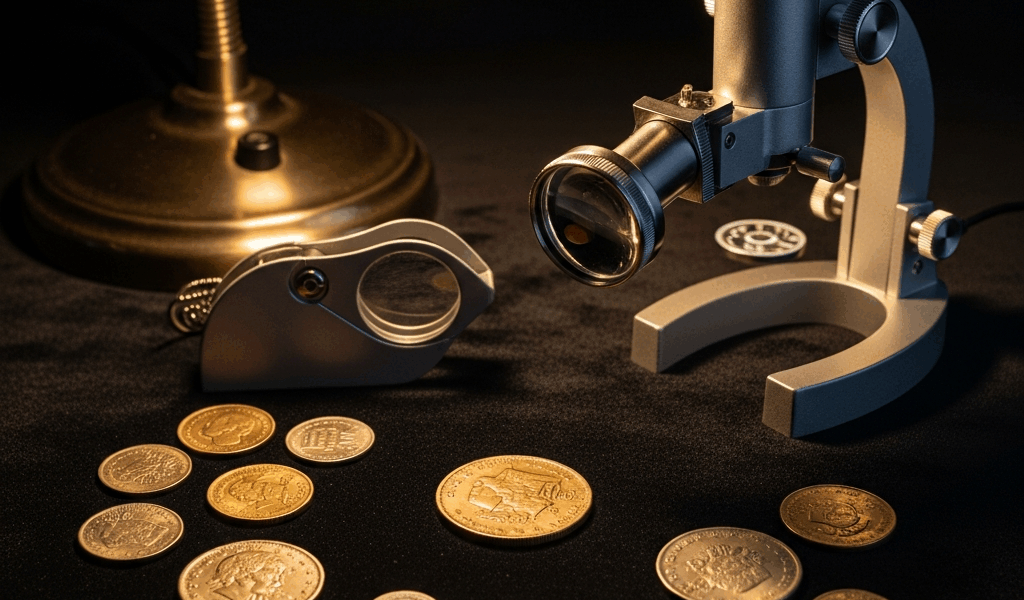
Best Coin Magnifier for Collectors — Loupe vs USB Microscope
Finding the best magnifier for coin collecting is one of those decisions that looks simple from the outside and turns out to matter enormously once you actually start examining coins seriously. I’ve been collecting since my early twenties, starting with a cheap plastic magnifier from a dollar store, and I can tell you that the wrong tool doesn’t just make examination harder — it makes you wrong. You’ll miss die markers. You’ll misgrade surfaces. You’ll squint at a coin for ten minutes and still not know if that’s a genuine doubled die or just a reflection artifact. The magnification tool you use shapes what you see, full stop.
This isn’t a roundup of every magnifier on the market. It’s a collector-specific breakdown of what you actually need, at what magnification, and for which tasks. There’s a meaningful difference between examining a coin for grading purposes and identifying a specific variety, and those two tasks don’t always call for the same tool.
What Magnification You Actually Need
Probably should have opened with this section, honestly. Most people buy a magnifier before understanding what they’re trying to see, which is how they end up with a 100x zoom that’s useless for anything practical or a drugstore reading glass that can’t resolve die polish lines.
Here’s how magnification breaks down for coin work specifically:
10x — The Standard for Grading
The numismatic industry grades coins at 10x magnification. That’s not an accident or arbitrary convention. At 10x, you can see contact marks, hairlines, luster flow, and surface quality without the visual noise that higher magnification introduces. When a professional grading service like PCGS or NGC evaluates a coin, they’re working at 10x. If you want your grading assessments to align with theirs, you grade at 10x too.
This is the magnification you’ll use most often. Every single session. When you’re looking at a Morgan dollar under bright light trying to decide if those marks in the field are bag marks or cleaning. When you’re checking a Walking Liberty half for wear on the hand and thumb. Ten times. That’s your baseline.
20x to 40x — Variety Identification and Die Markers
Variety work is a different discipline entirely. If you’re hunting for RPMs (repunched mintmarks), DDOs (doubled die obverses), or specific VAM varieties in Morgan dollars, 10x often isn’t enough. You need 20x to 40x to see the secondary mintmark image clearly or to confirm the specific die markers that distinguish one variety from another.
At this magnification range, depth of field gets shallow and your hand steadiness becomes a real issue. A small stand or a loupe rest helps significantly. I’ve also found that the quality of the optics matters even more at higher magnification — distortion that you barely notice at 10x becomes genuinely disorienting at 30x.
Above 40x — Usually More Trouble Than It’s Worth
Higher magnification sounds impressive. It’s rarely useful in practice. At 60x or 100x, you’re looking at such a tiny area of the coin that orienting yourself becomes difficult, and surface vibration from your own hands blurs everything. The exceptions are USB microscopes with physical stands, which we’ll get to. Handheld loupes above 40x are almost universally a bad purchase for coin examination.
Best Handheld Loupes for Coin Grading
Burned by a $12 multi-lens loupe set I ordered early in my collecting days, I eventually learned that optical quality is not a marketing distinction — it’s the difference between seeing a coin accurately and seeing a distorted, color-fringed version of it.
Bausch and Lomb Hastings Triplet 10x
This is the loupe. The one that professional numismatists have used for decades. A triplet lens design means three optical elements cemented together, which dramatically reduces chromatic aberration (that annoying color fringing on high-contrast edges) and field curvature. The Bausch and Lomb Hastings Triplet 10x runs around $60 to $80 depending on where you buy it — typically available through Amazon or specialty optical suppliers like Edmund Optics.
The field of view is flat edge to edge. The color rendition is accurate. It folds into a compact metal housing that fits in a pocket. I’ve had mine for nine years and it’s still sharp. This is the loupe I’d recommend to anyone who’s serious about grading their own coins or buying at shows where you need to make quick, accurate assessments on the spot.
It feels like a lot of money for something so small. It isn’t. A single misgraded purchase on a key-date coin will cost you far more than the price of a quality loupe.
BelOMO 10x Triplet
Made in Belarus, the BelOMO 10x is the budget-conscious alternative that doesn’t actually compromise on optical quality. It uses the same triplet construction as the Bausch and Lomb at roughly half the price — you can find it for around $28 to $35 on Amazon. The housing is plastic rather than metal, which feels less premium, but the glass is genuinely good.
Coin dealers who do high volume often carry BelOMOs as backup loupes or keep them at their tables for customers to use. That says something about their reliability. If the Bausch and Lomb feels like too much to start with, the BelOMO is an honest, capable alternative. Not a compromise — a sensible choice.
What to Avoid
Avoid the multi-lens folding sets that include a 10x, 20x, and 30x lens in a single plastic housing for under $15. These use simple doublet or singlet lenses with significant edge distortion and chromatic aberration. The images look wrong without you necessarily knowing why, which is the worst possible situation for evaluation work. Avoid jeweler’s loupes marketed at high magnification without specifying triplet or achromatic construction. Avoid anything with plastic optical elements.
The loupe market has a lot of garbage in it. The good products are well-known and consistent. Stick to BelOMO or Bausch and Lomb at 10x, and you won’t go wrong.
USB Microscopes for Coin Photography
A USB microscope connects to your computer or phone, displays a live image on screen, and lets you capture photographs or video of coins at significant magnification. They’re not primarily a hand-examination tool — they’re a documentation and photography tool. The distinction matters for how you evaluate them.
Plugable USB Microscope
The Plugable USB Digital Microscope (model USB2-MICRO-250X) is consistently one of the better-reviewed options for coin photography. It runs around $40 and connects via USB to a Mac or Windows computer. Magnification ranges from 10x to 250x, though anything above 60x or 80x on coins starts showing you more vibration than coin surface.
The practical sweet spot for most coin photography is 20x to 50x — close enough to show die detail, far enough to give useful context. The Plugable has decent built-in LED lighting and ships with a flexible stand that holds the microscope steady over the coin. That stand is critical. Handheld USB microscopes are nearly impossible to use effectively for still photography.
Jiusion 40x–1000x USB Microscope
The Jiusion is the popular budget option and shows up everywhere in coin photography discussions online. It costs around $25 to $30 and claims a 40x to 1000x range. Ignore the top-end number — 1000x on a $30 USB microscope produces an image with essentially no useful information. At 40x to 100x it performs reasonably well for the price.
What I’ve found with the Jiusion is that lighting control matters more than the microscope itself. The built-in LED ring is harsh and creates blown-out highlights on reflective proof surfaces. Diffusing the light with a piece of white tissue paper taped over the LEDs makes a surprising difference. For documentation of circulated coins or mint state business strikes, the Jiusion does the job. For proof coins or coins with mirror fields, you’ll fight the lighting constantly.
Lighting — The Variable That Actually Controls Image Quality
Every coin photographer learns this eventually. Magnification is not the limiting factor. Lighting is. A well-lit coin at 20x reveals more than a poorly lit coin at 60x. Raking light (coming from a low angle) shows surface texture and flow lines. Diffused overhead light shows color and luster. Direct harsh light blows out reflective surfaces and obscures detail.
Experiment with a small LED desk lamp positioned at different angles before assuming your microscope isn’t good enough. Move the light source. Diffuse it with copy paper. Try a flashlight at a steep angle for showing die flow. The coin will tell you what lighting reveals the most — you just have to try different setups rather than buying more expensive equipment.
The Verdict — Start with a Good 10x Loupe
Every collector needs a quality 10x loupe first. Everything else is secondary. The loupe is your primary examination tool for grading, for buying at coin shows, for checking coins when they arrive in the mail, for comparing a coin against its PCGS or NGC photo certificate. It’s the tool you’ll reach for a hundred times before you reach for a USB microscope once.
Start with the BelOMO 10x if you’re budget-conscious — spend $30, examine coins accurately, and decide later if you want to upgrade to the Bausch and Lomb. Add a USB microscope when you find yourself wanting to document varieties, photograph collections for insurance or sale, or share images online with other collectors. The Plugable is worth the extra $15 over the Jiusion if you care about image quality. The Jiusion is fine if you primarily want to show coins to friends or post casual images.
Do not buy cheap multi-lens sets. They create a false sense of capability while actually making examination harder. Optical distortion doesn’t announce itself — you just gradually make worse assessments and don’t understand why.
The sequence that makes sense: quality 10x loupe first, USB microscope when documentation becomes important, higher-magnification triplet loupe (20x to 30x) only if you’re doing serious variety work in a specific series. Most collectors — even advanced ones — live at 10x for 90 percent of their examination time. Gear up for the work you’re actually doing, not the most impressive number on the box.

Stay in the loop
Get the latest numisma master updates delivered to your inbox.