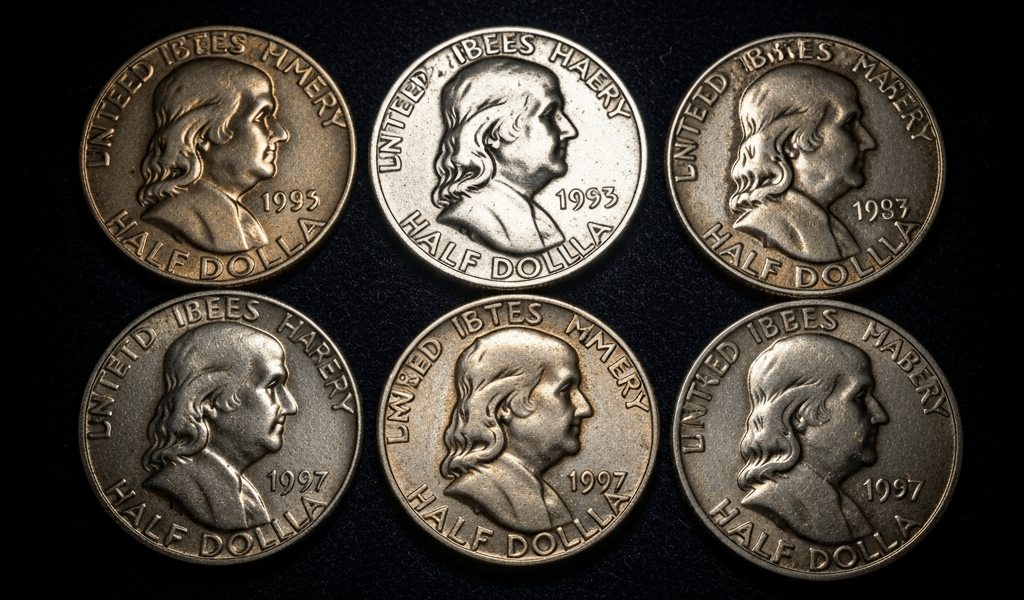
Franklin Half Dollar Value by Year and Mint Mark
Franklin half dollar pricing has gotten complicated with all the misinformation flying around — forums arguing over grades, dealers marking up mediocre coins, eBay listings that make no sense until you dig into the sold history. As someone who’s spent five years haunting coin shows and squinting through a 10x loupe at Liberty Bell reverses, I learned everything there is to know about what actually moves the needle on these coins. Today, I will share it all with you.
My first real mistake was a $40 overpayment on a 1949-S I thought was uncirculated. Turned out the bell lines were mush. MS-60 at best. Don’t make my mistake. The date on the coin is just the starting point — year, mint mark, grade, and Full Bell Lines together determine what a Franklin half dollar is actually worth. Get one of those wrong and you’re overpaying or underselling.
What Affects Franklin Half Dollar Value
Four things matter here. Year. Mint mark. Grade. Full Bell Lines.
But what is a Franklin half dollar, really? In essence, it’s a 90% silver 50-cent piece struck from 1948 through 1963, designed by John Sinnock and featuring Benjamin Franklin on the obverse and the Liberty Bell on the reverse. But it’s much more than that — it’s a series where tiny differences in strike quality can swing a coin’s value from $18 to $350 on the same date.
Philadelphia struck coins with no mint mark. Denver used a D. San Francisco used an S. Mintage volumes varied wildly across those three facilities, and that scarcity — or lack of it — drives the price foundation before you even consider condition.
Grade is where most people stumble. A circulated Franklin in Fine trades for pocket change above silver melt. The same date in MS-65 runs ten times that. And then there’s the Full Bell Lines question, which I’m apparently more obsessed with than most collectors I know — a PCGS-certified FBL coin works for me while a raw ungradeable example never seems to land at a fair price when I try to sell it later.
FBL means the horizontal lines across the Liberty Bell reverse are crisp and complete, top to bottom. Worn dies or off-center strikes blur those lines. I’ve watched 1948 Franklins with flat bell lines sit at $12 while a sharp FBL example of the exact same date sells for $55. Same year. Same mint. Totally different coin.
Franklin Half Dollar Value Chart by Year and Mint Mark
Probably should have opened with this section, honestly. Here’s the meat of what most people came here to find:
| Year | Mint Mark | Circulated (G–XF) | MS-60 to MS-63 | MS-64+ / FBL |
|---|---|---|---|---|
| 1948 | P | $7–$12 | $18–$28 | $45–$75 |
| 1948 | D | $7–$12 | $18–$26 | $40–$65 |
| 1948 | S | $7–$12 | $20–$32 | $50–$90 |
| 1949 | P | $7–$13 | $18–$30 | $45–$80 |
| 1949-S | S | $35–$65 | $120–$180 | $280–$450 |
| 1950 | P | $7–$12 | $16–$26 | $40–$70 |
| 1950 | D | $7–$12 | $16–$24 | $38–$65 |
| 1951 | P | $7–$12 | $16–$26 | $40–$70 |
| 1951 | D | $7–$12 | $16–$24 | $38–$65 |
| 1952 | P | $7–$12 | $16–$26 | $40–$70 |
| 1952 | D | $7–$12 | $16–$26 | $40–$70 |
| 1953 | P | $7–$13 | $18–$30 | $45–$80 |
| 1953-S | S | $22–$50 | $100–$165 | $240–$400 |
| 1954 | P | $7–$12 | $16–$26 | $40–$70 |
| 1954 | D | $7–$12 | $16–$26 | $40–$70 |
| 1955 | P | $18–$35 | $75–$135 | $200–$350 |
| 1955-D | D | $18–$35 | $70–$130 | $190–$340 |
| 1955-S | S | $18–$40 | $85–$155 | $220–$400 |
| 1956 | P | $7–$12 | $16–$26 | $40–$70 |
| 1956 | D | $7–$12 | $16–$26 | $40–$70 |
| 1957 | P | $7–$12 | $16–$26 | $40–$70 |
| 1957 | D | $7–$12 | $16–$26 | $40–$70 |
| 1958 | P | $7–$12 | $16–$26 | $40–$70 |
| 1958 | D | $7–$12 | $16–$26 | $40–$70 |
| 1959 | P | $7–$12 | $16–$26 | $40–$70 |
| 1959 | D | $7–$12 | $16–$26 | $40–$70 |
| 1960 | P | $7–$12 | $16–$26 | $40–$70 |
| 1960 | D | $7–$12 | $16–$26 | $40–$70 |
| 1961 | P | $7–$12 | $16–$26 | $40–$70 |
| 1961 | D | $7–$12 | $16–$26 | $40–$70 |
| 1962 | P | $7–$12 | $16–$26 | $40–$70 |
| 1962 | D | $7–$12 | $16–$26 | $40–$70 |
| 1963 | P | $7–$12 | $16–$26 | $40–$70 |
| 1963 | D | $7–$12 | $16–$26 | $40–$70 |
All values reflect recent market activity. Circulated means the coin saw actual pocket use — visible wear, flattened high points, that kind of thing. MS-60 through MS-63 are uncirculated but carry bag marks or light handling from the mint bag. MS-64 and above means minimal surface distractions, and any FBL premium stacks on top of that — at least if the bell lines actually hold up under a 10x loupe.
Key Dates and Rare Varieties Worth More
Not every Franklin half dollar trades close to silver melt. Some years just hit differently.
1949-S — The Low Mintage Starter Rarity
San Francisco pressed only 3.7 million 1949-S halves. Sounds like plenty until you realize most of them spent the 1950s and 60s rattling around cash registers and change jars. Finding a worn 1949-S is easy enough. Finding one in genuinely uncirculated condition — sharp bell lines, no bag marks worth mentioning — that’s a different hunt entirely. Prices run from $35 on a well-worn circulated example to $450 or more for an MS-65 FBL piece. That’s the coin that burned me early on. Lesson learned slowly.
1953-S — Another San Francisco Scarcity
The 1953-S clocked in at just 4.1 million coins. Same basic story as the 1949-S — circulated examples turn up regularly, high-grade survivors don’t. MS-64 FBL examples have been selling in the $350–$400 range at recent shows. For collectors working a tighter budget, the 1953-S in circulated grades at $22–$50 is honestly better value than the 1949-S — slightly less glamorous, still genuinely scarce, and dealers don’t mark them up as aggressively.
1955 — All Three Mint Marks Are Key Dates
Philadelphia turned out only 3 million halves that year. Denver did 3.1 million. San Francisco hit 3.7 million. All three numbers are drastically low against every other year in the series. That’s what makes 1955 endearing to us Franklin collectors — it’s one of the only years where you can’t pick up any mint mark without paying a real premium. A circulated 1955-P runs $18–$35 raw. Non-FBL MS-63 jumps to $75–$135. FBL versions push $200–$350. The 1955-D and 1955-S track close to those numbers, with the S running slightly higher on collector demand.
Doubled Die and Repunched Mint Mark Varieties
These exist — a 1949-D with a repunched D, a 1954-D with doubled die elements — and the premiums are real. Fifty to two hundred percent over the standard coin, depending on the variety and the grade. The catch is that most of these require expert authentication or a PCGS/NGC slab to command serious money. While you won’t need a full reference library to start collecting Franklins, you will need a decent loupe and at least one good variety guide if you’re going hunting for these. Don’t eyeball a repunched mint mark and assume you’ve struck gold. Get it certified first.
How to Grade Your Franklin Half Dollar at Home
You don’t need professional numismatist credentials to make a reasonable grade call on your own coins. So, without further ado, let’s dive in.
Circulated Coins — Look for Wear Patterns
Good (G): Design is still readable but heavily worn smooth across all the high points. Liberty’s profile looks almost featureless. Eagle breast feathers are basically flat.
Fine (F): Moderate wear throughout. Liberty’s cheek shows some definition coming back. Eagle feathers worn but still distinct from each other.
Extra Fine (XF): Light wear only on the very highest points. Liberty’s hair shows texture. Eagle feathers are crisp — just the tips of the tallest points may be slightly flattened.
Uncirculated Coins — The Bell Lines Are Everything
An MS-60 or better Franklin has zero wear. None. But uncirculated alone isn’t the whole story — tilt the coin under your loupe and check that Liberty Bell reverse. The horizontal lines running across the bell should be sharp and complete from top rim to bottom. Mushy lower lines mean a weak strike or worn dies. No FBL designation. A typical MS-63 non-FBL coin might fetch $18–$30. The same date in MS-63 FBL jumps to $50–$100. That $30–$70 gap isn’t hiding some defect in the non-FBL piece — it just reflects rarity within the grade. Press conditions on that particular day weren’t great. Happens all the time in this series.
Where to Sell or Buy Franklin Half Dollars
First, you should check eBay sold listings before anything else — at least if you want an honest read on current market prices. Filter by date and mint mark, look only at completed sales, ignore the outlier auction that closed at double normal value because two stubborn bidders got into it. The middle of the sold range is your real number.
Coin shows might be the best option for buying, as Franklin half dollar collecting requires hands-on inspection. That is because grading these coins from photos alone is genuinely risky — bell line quality doesn’t always photograph well, and lighting tricks can mask bag marks. At a show you can inspect the coin directly, and dealers tend to price more competitively when they’ve got competition three tables over.
For the key dates — 1949-S, 1953-S, anything from 1955 — stick with PCGS or NGC certified coins in higher grades. Grading fees run roughly $25–$35 per coin through standard service. That math only works on coins worth $100 or more raw, so don’t bother submitting a common-date circulated Franklin. Local dealers are fine for bulk circulated Franklins, especially selling. Most will pay near silver melt — around $4–$5 per coin depending on spot price that day. Not exciting. But fast and honest, and sometimes that’s exactly what you need.

Stay in the loop
Get the latest numisma master updates delivered to your inbox.