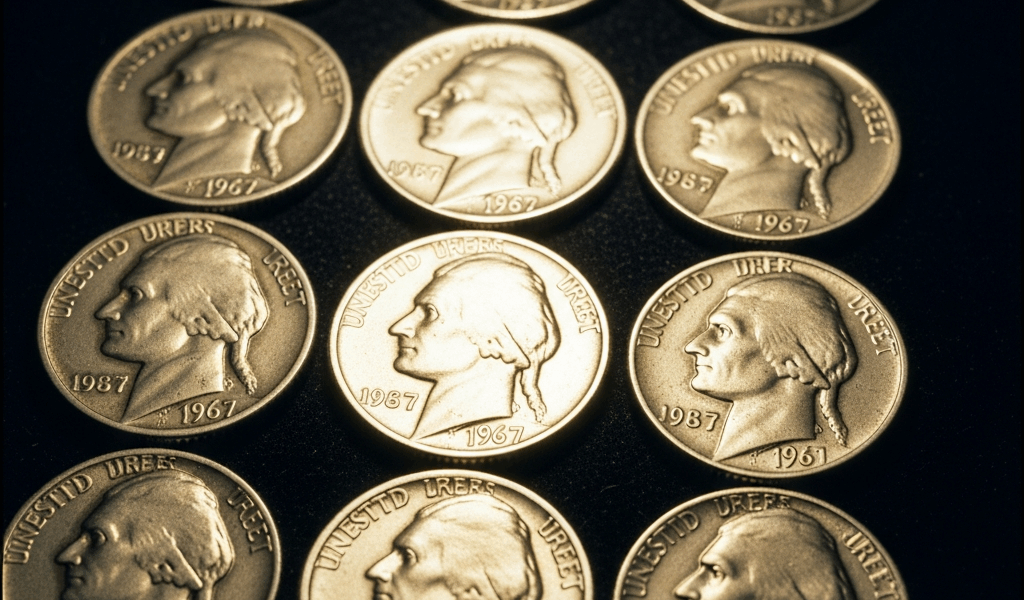
What Makes a Jefferson Nickel Valuable
Jefferson nickel collecting has gotten complicated with all the misinformation flying around about which coins are actually worth money. As someone who has spent years cracking open bank rolls in search of key dates, I learned everything there is to know about jefferson nickel value by year and mint mark. Today, I will share it all with you.
Three things determine value. The year. The mint. And condition. That’s it. The mint mark — that tiny letter stamped on the reverse below Monticello — tells you immediately where the coin came from. P means Philadelphia (though Philadelphia coins carried no mark at all before 1980), D means Denver, S means San Francisco. Some years, one mint cranked out tens of millions of coins while another barely struck a few hundred thousand. A 1942-D nickel is worth dramatically more than a 1942-P for exactly that reason — Denver produced far fewer that year.
But what is coin grading, really? In essence, it’s a standardized way to describe how much wear a coin shows. But it’s much more than that. A pristine uncirculated specimen of a completely common date can fetch five times what a worn example brings. Use the Sheldon Scale — check Jefferson’s cheek, the steps on Monticello, and the lettering rim for signs of wear.
One more thing separates premium coins from the rest: Full Steps designation. If the five or six steps leading up to Monticello are crisp and unflattened, collectors pay serious money. I’ll break that down in detail below.
And then there’s silver. From 1942 through 1945, the U.S. Mint switched to a 35% silver composition to conserve nickel for wartime ammunition. These coins carry actual melt value on top of any numismatic premium — their own collecting category entirely.
Wartime Silver Jefferson Nickels (1942 to 1945)
Probably should have opened with this section, honestly. Every single person who finds a nickel from these four years asks me the same question — is it silver? Yes. Here’s how to tell in about three seconds.
Flip the coin over. Above the Monticello building on the reverse, you’ll see a large, boldly punched mint mark. On regular pre-1942 and post-1945 nickels, the mark is tiny or missing altogether. The wartime coins got an oversized punch specifically to signal the composition change to the public. P, D, and S all appear in this larger format throughout those four years.
The silver content changes the feel of the coin. They sit slightly heavier in the palm than a modern nickel. Tap one against another wartime example — the ring is noticeably sharper. I’m apparently very sensitive to that sound difference, and it works for me while eyeballing dates alone never quite does.
As of late 2024, raw silver trades around $30 per troy ounce. Each nickel holds roughly 1.75 grams of silver — worth approximately $1.50 in pure bullion. Rarity and grade push the premiums considerably higher than that floor. Here’s what circulated versus uncirculated wartime nickels actually trade for:
- 1942-P: Circulated $2–4 | Uncirculated $8–18
- 1942-D: Circulated $3–6 | Uncirculated $12–35
- 1942-S: Circulated $2–4 | Uncirculated $8–15
- 1943-P: Circulated $2–3 | Uncirculated $6–12
- 1943-D: Circulated $3–5 | Uncirculated $10–25
- 1943-S: Circulated $2–3 | Uncirculated $6–10
- 1944-P: Circulated $2–3 | Uncirculated $6–12
- 1944-D: Circulated $3–5 | Uncirculated $10–22
- 1944-S: Circulated $2–3 | Uncirculated $6–10
- 1945-P: Circulated $2–3 | Uncirculated $6–12
- 1945-D: Circulated $3–5 | Uncirculated $10–20
- 1945-S: Circulated $2–3 | Uncirculated $6–10
The 1942-D stands out as the most valuable common wartime date in circulated condition. Denver’s lower mintage that year is the whole story. Mint State examples grading MS63 to MS65 routinely sell for $30 to $50 — sometimes more at the right auction.
Jefferson Nickel Value Chart by Year and Mint Mark
Nickels from 1938 through the early 1970s form the main collecting range. Old jars, estate lots, bank rolls — that’s where most of these surface. So, without further ado, let’s dive in. Rather than list every year robotically, I’ve grouped common dates and flagged the keys that actually change the math on value.
Early Years: 1938–1941 (Pre-War, 56% Copper-Nickel)
- 1938-D, 1938-S: Low mintage. Circulated $1.50–3 | Uncirculated $6–15
- 1939-D: Key date. Circulated $4–8 | Uncirculated $20–60
- 1939-P, 1939-S: Common. Circulated $0.50–1.50 | Uncirculated $3–8
- 1940–1941 (All Mints): Common dates. Circulated $0.50–1 | Uncirculated $2–5
The 1939-D is the classic key to the early series. Fewer than 3.5 million struck — and most of those spent decades rattling around in pocket change. Finding one in uncirculated condition is genuinely rare. I’ve opened hundreds of bank rolls over the years and pulled maybe two clean examples total. That’s what makes the 1939-D endearing to us Jefferson collectors.
Wartime: 1942–1945 (35% Silver, Large Mint Mark)
See the dedicated wartime section above for full breakdowns. Short version: 1942-D tops the value list for this entire period.
Immediate Post-War: 1946–1954
- 1950-D: Absolute key date. Circulated $8–20 | Uncirculated $40–150
- 1948-D, 1949-D: Semi-key. Circulated $2–4 | Uncirculated $8–20
- 1950-P, 1950-S: Common. Circulated $0.50–1 | Uncirculated $2–5
- 1946–1954 (Other Dates): Common. Circulated face value | Uncirculated $1–3
The 1950-D owns the reputation as the single toughest Jefferson nickel to find — and it earns that reputation. Denver struck just 2.6 million that year. Nearly all of them went straight into circulation. An MS64 example sells for $100 to $150 on today’s market without breaking a sweat. Don’t make my mistake — I once dismissed an entire sleeve of 1950s nickels as junk without checking individual mintages. Learned that lesson the hard way.
Mid-Series: 1955–1970
- 1955-D, 1955-S: Scarce dates. Circulated $1–2 | Uncirculated $4–10
- 1956–1965 (All Mints): Common. Circulated face value–$0.50 | Uncirculated $1–2
- 1966–1970 (All Mints): Very common. Circulated face value | Uncirculated $0.50–1
High production across all three mints through these years means most coins saw heavy circulation. Uncirculated rolls from this era do turn up — but usually through dealer inventory or specialty auction lots, not casual bank roll searching.
Modern Dates: 1971–Present
Post-1970 Jefferson nickels carry essentially no numismatic value unless they show a minting error or a Full Steps designation. Worth noting: the mint mark moved to the obverse — that’s the front — starting in 1980, and shrank back down to a tiny punch. Circulated modern examples trade at face value. Uncirculated rolls from major dealers run about $1.50 to $2 per coin on common dates. Nothing exciting here.
Full Steps Nickels and Why They Command a Premium
But what is a Full Steps nickel? In essence, it’s a coin where the staircase leading up to Monticello on the reverse shows complete, unflattened step lines. But it’s much more than that — it signals a coin struck from fresh dies, handled carefully, and spared from the abuse of circulation.
Grading services distinguish between 5FS (five clear steps) and 6FS (six steps, meaning even the lowest step shows sharp detail). The 6FS designation commands a noticeably higher premium. Certified 6FS specimens in top grades are legitimately scarce on many dates.
Here’s a concrete example. A 1943-P nickel grading Mint State 65 — uncirculated, attractive surfaces — might sell for $12 to $15. Slap a Full Steps certification on that same coin and it jumps to $25 to $40. The date hasn’t changed. The silver content is identical. What changed is eye appeal and rarity at that specific grade level.
I’m apparently a magnet for undervalued lots. I once bought a bulk group of twenty early-1960s nickels — paid maybe $8 total — thinking they were filler. Under a 10x loupe, two of them showed crisp, complete step detail. Sent both to PCGS for grading. They came back MS65 Full Steps. The pair sold for $85 combined. Don’t make my mistake of skipping magnification on any lot from that era.
Common-date Full Steps coins from 1960 to 1970 trade for $5 to $15 depending on grade. Semi-key dates like the 1948-D in 6FS condition can push $50 to $100. True keys like the 1950-D with Full Steps certification are genuinely scarce — $200 to $500 or more when they surface.
How to Tell If Your Jefferson Nickel Is Worth Selling
Found a handful of old nickels? Here’s the fastest way to sort keepers from pocket change.
Step one: Check the reverse for that large oversized mint mark above Monticello. P, D, or S in big bold letters means 1942–1945 wartime silver. Separate those immediately — they’re worth at least $2 to $3 each even heavily circulated.
Step two: Note the date and mint mark combination. Cross-reference against the chart above. A 1939-D, 1942-D, or 1950-D changes the conversation entirely. A 1965-P does not.
Step three: Assess condition honestly — at least if you want an accurate sense of real-world value. Hold the coin at eye level under a bright incandescent bulb. Wear shows first on Jefferson’s cheek and the Monticello step lines. Deep original luster signals uncirculated. Flat, gray surfaces signal decades in a pocket.
Step four: Decide whether professional grading makes financial sense. A certified 1943-P in average grade? Probably not worth the $15 to $20 submission fee. A 1950-D in pristine condition? Send it in without hesitation. PCGS and NGC both carry serious weight with collectors and can add $5 to $50 or more depending on the date and grade result.
Step five: Know your selling options. Local coin dealers offer fast cash — though expect lowball offers, usually 50 to 60 cents on the dollar. eBay captures true collector premiums if you’re patient and photograph honestly. Coin shows let you price things yourself and read the market in real time. For wartime silver nickels in bulk quantity, a bullion dealer might offer spot-plus-premium pricing with no hassle at all.
Searching through old rolls methodically builds patience fast. Most dates are common. Most coins are worn. But that 1950-D or 1939-D sitting quietly in the pile — that’s exactly the one worth the hunt.

Stay in the loop
Get the latest numisma master updates delivered to your inbox.