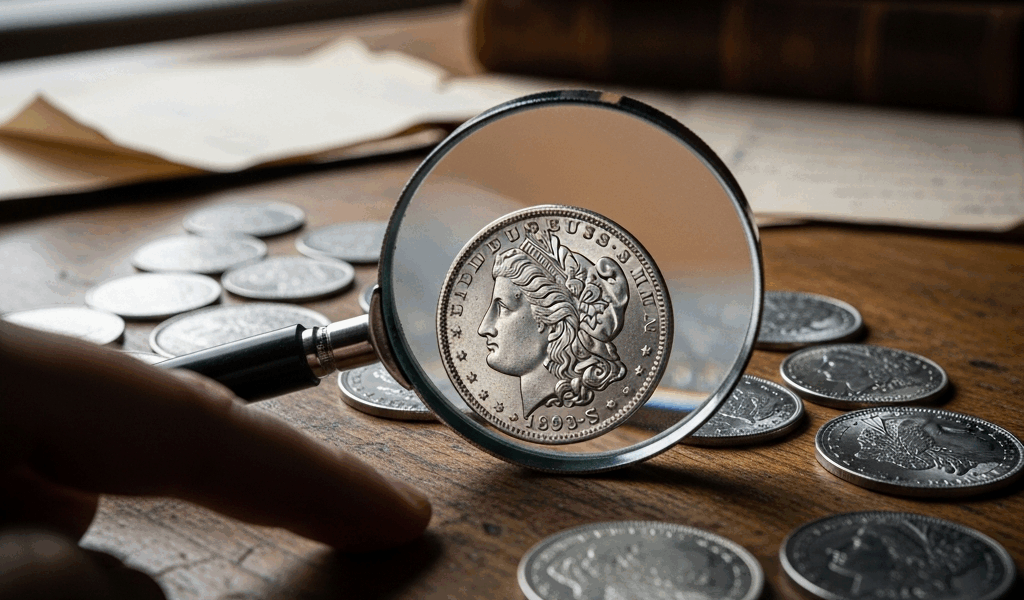
How to Read Your Morgan Dollar Before Looking Up Value
Morgan dollar pricing has gotten complicated with all the misinformation flying around — especially online, where half the “guides” skip the most important step entirely. I spent three years cataloging inherited coin collections, and I learned everything there is to know about the single mistake that costs people real money. Today, I will share it all with you.
The mistake? Looking up the wrong coin. Someone grabs a Morgan dollar, glances at the date, misses the mint mark completely. Then they compare their 1881-S — worth real money — to pricing for a common 1881 Philadelphia strike. Completely different coins. Completely different values. Frustrating. Preventable.
Here’s what you need in about 60 seconds.
The date sits on the obverse — Lady Liberty’s side — centered right below her neck. Hard to miss. The mint mark lives on the reverse, above the word DOLLAR, tucked between the eagle’s tail feathers and the denomination. It’s small. Really small. Squint-at-it-under-a-lamp small. S means San Francisco. CC is Carson City. O is New Orleans. D is Denver. No letter at all? Philadelphia. If you flip the coin and see nothing up there, you’ve got a Philly strike.
For grading yourself: hold the coin under decent light — a $12 LED desk lamp works fine. Focus on the high points. Liberty’s cheek. The eagle’s breast feathers. Good condition means heavy wear, flattened details, design barely hanging on. Fine means the design reads clearly but feels worn smooth at the peaks. Very Fine brings sharper definition back. About Uncirculated looks nearly new with just light friction at the highest spots. Mint State means it never left the bank. That’s your rough framework, and it’s honestly enough to get started.
Probably should have opened with this section, honestly, because everything below depends on reading your coin correctly first.
Morgan Dollar Key Dates and What They Are Worth
But what are key dates? In essence, they’re coins struck in tiny quantities or ones that survived in brutally low numbers. But it’s much more than that — they’re the coins that command serious premiums regardless of grade, and they’re worth knowing before you move on to anything else. So, without further ado, let’s dive in.
1893-S
Frustrated by plummeting silver demand, the San Francisco Mint produced only 100,000 pieces of the 1893-S using standard dies and tight production schedules. The survival rate is brutal. Most got melted down in later decades. A Good example runs $800–$1,200 today. Fine jumps to $1,400–$2,000. Very Fine lands at $2,000–$3,200. AU, $3,500–$5,500. MS-63, $8,000–$14,000. Even a beat-up, heavily worn example carries four-figure value. That’s rare for any coin.
1895 (Proof Only)
Only one year in the entire Morgan dollar run produced proof-only strikes: 1895. No business strikes. None. The original mintage was 880 pieces — less than a thousand coins made for a year that simply shouldn’t exist in circulation. A Proof-60 runs $6,000–$10,000. Proof-63, $12,000–$18,000. Proof-65, $25,000 and up. If you own one, you already know what you have.
1889-CC
Carson City had political weight — Western mint, Western silver interests, limited annual output. The 1889-CC saw 350,000 struck, which sounds reasonable until you look at preservation rates. Good condition fetches $350–$600. Fine, $700–$1,000. VF, $1,200–$1,800. AU, $2,000–$3,500. MS-63, $5,000–$8,000. CC coins carry collector premiums across the board anyway. This specific date amplifies that premium considerably.
1884-S
San Francisco struck 3,200,000 pieces in 1884 — not a tiny mintage by any measure, but the 1884-S turns genuinely elusive in higher grades. Finding a nice one takes patience. Good runs $120–$200. Fine, $250–$400. VF, $450–$700. AU, $1,000–$1,600. MS-63, $3,500–$6,000. Worn examples are accessible enough. Anything nicer disappears fast at auction.
1893-CC
Only 677,000 struck that year in Carson City. Good condition runs $250–$400. Fine, $500–$800. VF, $900–$1,400. AU, $1,800–$3,000. MS-63, $4,500–$7,500. The Carson City pedigree matters here as much as the low production numbers — collectors chase the CC mint mark obsessively, and this date sits right at the intersection of both factors.
Semi-Key Morgan Dollars Most Collectors Actually Find
Most people clearing out a safety deposit box or settling an estate find semi-key Morgans rather than true keys. These occupy solid middle ground — genuinely worth finding, not scarce enough to break four figures in average grades, but consistently valuable across conditions. That’s what makes semi-keys endearing to us collectors.
1901
Philadelphia had a strange year. Only 3.3 million pieces struck, which stands out noticeably against other early-1900s Philadelphia issues. It shows up in old collections more than you’d expect — apparently grandparents held onto these specifically.
- Good: $80–$130
- Fine: $140–$220
- VF: $280–$450
- AU: $700–$1,200
- MS-63: $2,000–$3,500
1903-S
San Francisco produced only 1.4 million pieces in 1903 — a legitimate scarcity for the period, not an artificially inflated one. These are genuinely hard to source in bulk.
- Good: $90–$150
- Fine: $180–$300
- VF: $400–$650
- AU: $1,000–$1,600
- MS-63: $2,500–$4,200
1892-S
Only 5.2 million struck. Not ultra-scarce on paper, but definitely tighter than the later San Francisco years that flooded the market.
- Good: $75–$120
- Fine: $130–$200
- VF: $250–$400
- AU: $650–$1,100
- MS-63: $1,800–$3,000
1896-S
Another low-production San Francisco date. Fewer circulated, which means fewer problem coins floating around — cleaner surfaces on average than comparable years.
- Good: $85–$140
- Fine: $160–$260
- VF: $350–$550
- AU: $900–$1,500
- MS-63: $2,200–$3,800
1894
Philadelphia, 1.2 million pieces struck. Scarce by absolute production numbers, collectible even in modest grades. One of those dates that rewards patient searching through old estate lots.
- Good: $95–$160
- Fine: $200–$320
- VF: $450–$700
- AU: $1,100–$1,800
- MS-63: $2,800–$4,500
The pattern matters here. Semi-keys hold value at every grade level. A Good-condition 1903-S is still worth nearly $100. Most inherited coins show up in Fine or VF — that puts them solidly in the $200–$650 range. Real money. Not five figures, but real money sitting in a cardboard box.
Common Date Morgan Dollar Values by Mint Mark
The vast majority of Morgans people actually find are common dates: 1921, 1878, 1879, 1880, 1881, 1882, 1883. Minted by the millions, surviving in similar proportions. Value depends almost entirely on mint mark and condition — two factors that matter enormously and get ignored constantly.
| Date & Mint | Good | Fine | VF | AU | MS-63 |
|---|---|---|---|---|---|
| 1921 (P) | $25–$35 | $35–$50 | $45–$70 | $90–$140 | $250–$400 |
| 1881-S | $30–$50 | $60–$90 | $110–$160 | $220–$350 | $700–$1,200 |
| 1880-CC | $45–$75 | $90–$140 | $160–$250 | $400–$650 | $1,200–$2,000 |
| 1879-O | $35–$60 | $75–$120 | $140–$220 | $300–$500 | $900–$1,500 |
| 1882 (P) | $22–$32 | $32–$48 | $50–$75 | $85–$130 | $220–$350 |
The melt floor for any Morgan dollar sits around $18–$22 depending on spot silver that week. Even a damaged common-date coin has inherent worth. But the mint mark premium is real and significant. A 1921 Philadelphia in Fine runs $35–$50. An 1881-S in identical Fine condition commands $60–$90. The Carson City premium runs steeper still — 1880-CC Fine lands at $90–$140 while a plain 1880 Fine sits at $35–$50. Collectors specifically hunt CC coins, and that demand shows up at every single price tier without exception.
What Kills a Morgan Dollar’s Value Instantly
I’m apparently a slow learner and buying coins impulsively works for me while checking surfaces carefully never stuck as a habit — at least not until an expensive lesson fixed that permanently. Don’t make my mistake.
I purchased what looked like an exceptional 1889-S in AU condition for $2,200. Excited about the price relative to catalog value. The coin arrived, and I immediately spotted hairline scratches under the reverse eagle and unnatural toning — bright red and green that looked almost painted on. A dealer friend looked at it for approximately four seconds and said, “Cleaned. Probably 1960s.” That coin dropped to $400 in retail value overnight. Learned that one at scale.
Cleaning is the single biggest value killer in this market. Even a light cleaning that removes original patina slashes value by 40–60 percent — even when the coin looks attractive to the naked eye. Heavy polishing is worse. PCGS and NGC, the two standard grading services, penalize cleaned coins hard. Sometimes they refuse premium holder labels entirely. A cleaned coin in a “details” holder sells at a steep discount to a naturally toned example in the same numeric grade.
Environmental damage hits similarly hard. Spots, verdigris — that’s green copper corrosion — and PVC damage from old soft plastic holders all tank value fast. A VF 1903-S worth $400–$650 with clean surfaces drops to $150–$250 with heavy spotting or embedded green patina in the fields. Same coin. Completely different sale.
Artificial toning might be the sneakiest problem. Not all toning is bad — original toning can genuinely add value on the right coin. But chemical dunking to create iridescent colors? Dealers and graders catch it. The colors are too uniform, too vivid, layered in ways that natural oxidation over decades simply doesn’t replicate. Avoid anything that looks like a tie-dye experiment.
Whizzing — running a wire brush or polishing wheel across the surfaces to fake luster — leaves a distinctive directional pattern that experienced buyers spot immediately. Grading services note it. The grade drops dramatically. The coin becomes almost unsellable at any reasonable price.
While you won’t need a full numismatic laboratory, you will need a handful of basic resources — at least if you want to protect yourself. First, you should submit any valuable coin to PCGS or NGC for professional grading — at least if the coin is worth more than $200–$300. The submission fee runs $35–$50 per coin. Cheap insurance against misreading condition and losing hundreds in a sale. NGC might be the best option for newer collectors, as Morgan dollar authentication requires familiarity with subtle surface issues. That is because cleaned and altered coins in this series are genuinely common, and graders see through them where most buyers won’t.
Morgan dollars remain the most collected American coins of the 19th and early 20th centuries. That sustained collector demand means inherited coins often carry real value — sometimes substantial value sitting forgotten in a drawer. Know the date. Find the mint mark. Grade condition honestly. Check for cleaning and damage. That process takes maybe 20 minutes and can mean the difference between $50 and $500 on a single coin.

Stay in the loop
Get the latest numisma master updates delivered to your inbox.