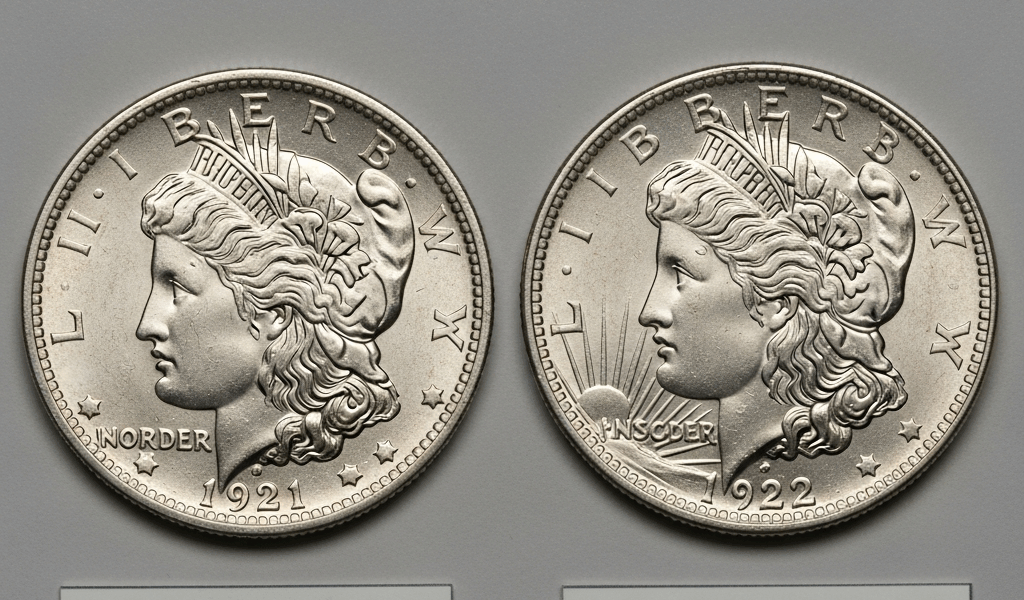
Peace Dollar vs Morgan Dollar — Two Silver Classics Compared
The peace dollar vs morgan dollar debate has gotten complicated with all the conflicting collector advice flying around. As someone who walked into a coin shop in 2014 clutching $400 and absolutely no idea what I was doing, I learned everything there is to know about American silver dollars the hard way. The dealer — older guy, reading glasses pushed up on his forehead — set two coins on a square of black velvet: a circulated 1922 Peace dollar and a well-worn 1881-S Morgan. I bought the Morgan. Ten years on, I still think that was the right call. But honestly? It depends entirely on what kind of collector you are.
The Historical Context — Why Two Different Silver Dollars?
Morgan dollars hit circulation between 1878 and 1904, then showed up again in 1921 after a 17-year absence. They came out of the Bland-Allison Act — essentially a political compromise forcing the U.S. Treasury to buy silver from western mining operations. That backstory matters more than people realize. These coins moved through saloons in Nevada, bank vaults in New Orleans, railroad payroll offices in Wyoming. You hold one and you’re holding something that genuinely lived through the Wild West and the Gilded Age.
The Peace dollar arrived in 1921 and ran through 1935. Specifically designed as a response to World War I ending — hence the word PEACE stamped on the reverse. The country was exhausted and cautiously optimistic, and this coin captured that mood in silver. It looks forward where the Morgan looks back.
Both coins are 90% silver, 10% copper. Both weigh 26.73 grams and measure 38.1mm across. Identical specs — completely different personalities. That personality gap is exactly why collectors tend to pick sides rather than just quietly accumulating both.
Design and Aesthetics — Which Coin Is More Visually Compelling?
But what is a Morgan dollar, visually? In essence, it’s a Victorian-era coin packed with ornate detail. But it’s much more than that — it’s practically a small sculpture.
George T. Morgan designed it in 1878, modeling Liberty’s face largely on Anna Willess Williams, a Philadelphia schoolteacher. The obverse shows Liberty in profile with a Phrygian cap and wreath. The reverse has a spread eagle — bold, dramatic, deeply struck — with arrows and an olive branch. Under a decent loupe — I use a 10x Bausch & Lomb I found at an estate sale for eleven dollars — the feather detail on a well-struck Morgan is genuinely impressive. It photographs well. It commands a display case.
The Peace dollar is Anthony de Francisci’s work. He modeled Liberty’s face on his wife, Teresa. The design is Art Deco — flowing, radiant, intentionally softer than Morgan’s version. The reverse shows an eagle perched on a rock with wings folded down, that PEACE inscription underneath. Elegant. Quieter. A completely different kind of beautiful.
My honest take: the Morgan wins on raw visual drama. Show either coin to someone who knows nothing about numismatics and wants to say “wow” — it’s the Morgan, every single time. The Peace dollar’s appeal grows on you more slowly. Neither is objectively better. They’re just built for different eyes.
Which Is Easier to Collect as a Complete Set?
Probably should have opened with this section, honestly, because for a lot of collectors this one question settles everything.
A complete Morgan dollar set — all business strikes, every date and mint mark combination — covers 28 coins. Sounds manageable. Then you hit the 1895-P. That coin exists only as a proof. Roughly 880 examples are known. You will not find one under $50,000, and a nice specimen grades into six figures without blinking. The 1895-P alone makes true completion essentially impossible for most human beings. Full stop.
Beyond that one nightmare coin, there are low-mintage Carson City issues, challenging San Francisco dates, and several other keys that will drain both your patience and your checking account. A realistic Morgan collection — 1878 through 1904 plus 1921, examples from the major mints in honest circulated grades — will run somewhere between $5,000 and $15,000 depending on how condition-obsessed you are and how long you’re willing to hunt.
Peace dollars tell a different story. Twenty-four date and mint mark combinations total. No proof-only issues hiding in the set. The key date is the 1921 — first year of issue, struck in high relief, lower mintage than anything that followed — but it’s actually findable. In Very Fine condition a 1921 Peace dollar runs $150 to $300. That’s a key date you can own without refinancing anything.
A complete Peace dollar set in circulated grades is achievable for $3,000 to $8,000. The entire set. Every date, every mint mark. Most Morgan collectors would stare at that number with something between envy and disbelief.
Value Trajectory — Which Series Has Performed Better?
Both series sit on a silver floor — that’s the baseline. With spot silver hovering around $28 to $30 per troy ounce right now, the melt value on either coin lands roughly at $20 to $22. You’re not losing money below that number in any realistic scenario. That floor matters psychologically, especially when you’re newer to this.
Above melt is where things split. Common Morgan dates — the 1881-S, the 1882-O, the 1883-O — typically trade at 2x to 3x melt in circulated grades. A heavily worn 1881-S might cost you $45 to $55 at a decent coin show. Common Peace dollars — the 1922 and 1923, struck by the tens of millions — trade closer to 1.5x to 2x melt. You can find them in the $30 to $40 range without working very hard.
Don’t make my mistake. I bought several common Peace dollars early on assuming they’d appreciate faster because the entry price was lower. They didn’t. The thin premium over melt on common Peace dates leaves almost no room for collector-driven price growth. Morgan key dates — particularly low-mintage Carson City issues like the 1879-CC or the 1889-CC — have historically outperformed Peace key dates on price appreciation over a 10 to 20 year window. Not dramatically. But measurably.
Morgan key dates cost more to enter, though. Higher upside, higher upfront cost. Peace dollars offer a more modest but more accessible profile. Honestly, neither series is going to make you rich. Both hold value better than almost anything else you could put $50 into on a Tuesday afternoon.
The Verdict — Which Should You Collect?
After a decade of handling both series — and making most of the beginner mistakes so you don’t have to — here’s where I actually land.
Collect Morgan dollars if:
- You want to own what most numismatists consider the single most iconic American coin series ever struck
- You have enough budget to pursue at least a few key dates rather than just accumulating common dates indefinitely
- The Gilded Age, frontier America, and the political fight over silver coinage genuinely interest you as history
- You want coins that photograph well and look dramatic displayed on a shelf
Collect Peace dollars if:
- Finishing a complete set actually matters to you — and with Morgans, true completion is essentially off the table for most collectors
- The cleaner Art Deco aesthetic appeals to you more than the ornate Victorian detail on the Morgan
- You’re newer to collecting and want a lower per-coin entry price across most of the set
- Post-WWI American history and the cultural mood of the 1920s genuinely interest you as a collecting theme
That’s what makes each series endearing to us collectors — the Morgan and the Peace dollar aren’t really competing. They’re two different arguments about what American silver coinage should feel like. Morgans are more visually impressive, more historically charged, stronger on key-date investment potential. Peace dollars are more completable, more affordable, and — apparently — chronically underappreciated by collectors who get dazzled by Morgans before giving the Peace dollar a real look.
Most serious collectors I know end up owning both eventually. The Morgan set ends in 1921. The Peace set begins in 1921. They overlap at exactly that one date — collecting one tends to pull you naturally toward the other. But if you’re standing in a coin shop right now with $400 in your pocket and you have to pick a direction? Go Morgan. Buy the best circulated example you can afford of a date that actually means something to you historically. You can always grab a common Peace dollar later for $35 and see how it sits in your hand.
These coins have been around for over a hundred years. They’ll wait.

Stay in the loop
Get the latest numisma master updates delivered to your inbox.