How to Store Silver Coins Long-Term Without Damage
Storing silver coins long-term has gotten complicated with all the conflicting advice flying around. As someone who pulled a ruined 1921 Morgan dollar out of a hardware store vinyl holder about seven years ago, I learned everything there is to know about archival storage, sulfur compounds, and what actually separates a preserved coin from a destroyed one. The edges had gone green. The surface felt faintly tacky. I’d effectively wrecked a perfectly original coin while trying to protect it — using a soft plastic flip I’d grabbed from a bin at a coin show, feeling pretty smart about it at the time. Don’t make my mistake.
The PVC Problem — Why Most Plastic Holders Damage Silver Coins
Polyvinyl chloride — PVC — is probably the single most destructive material you’ll encounter as a collector. It’s everywhere, honestly. Older 2×2 flips, soft vinyl tubes from hardware stores, certain coin album pages manufactured in the 1970s and 80s. But what is the actual problem with PVC? In essence, it’s a slow chemical migration process. But it’s much more than that.
PVC off-gasses plasticizers over time — those compounds migrate directly onto whatever silver coin you’ve placed inside. Green, sticky residue. Etching into the coin’s surface chemistry. Once that happens, it’s done. Acetone soaks can arrest the process, but the surface damage stays. The original luster is gone and it isn’t coming back.
The signs are recognizable once you’ve seen them once. Green slime collecting around the edges. Flips that used to be crystal clear now yellowed and slightly stiff. A faint chemical smell when you crack the holder open. If you’re picking up coins at estate sales or working through collections assembled before the mid-1990s, inspect every single holder. Assume nothing is fine until you’ve checked it yourself.
Safe alternatives exist and they aren’t expensive. Saflip Mylar flips have been the benchmark since the 1980s — there’s a reason serious collectors default to them. BCWS makes solid PVC-free 2×2 cardboard-and-Mylar flips that hold up well for bulk storage. PCGS and NGC certified hard plastic holders are completely inert. Intercept Shield products go a step further — a reactive polymer that actively neutralizes airborne sulfur compounds rather than just passively sitting around your coin. Never use soft vinyl tubes from hardware store bins. Not once. Not even temporarily.
Air-Tites vs 2×2 Flips vs Hard Plastic Holders — Which Is Best
Probably should have clarified this earlier, honestly — there’s no single right answer. The correct holder depends on what the coin is and what you’re doing with it. Burned by the PVC situation above, I eventually worked out a three-tier system that maps roughly to coin value and how often things get handled.
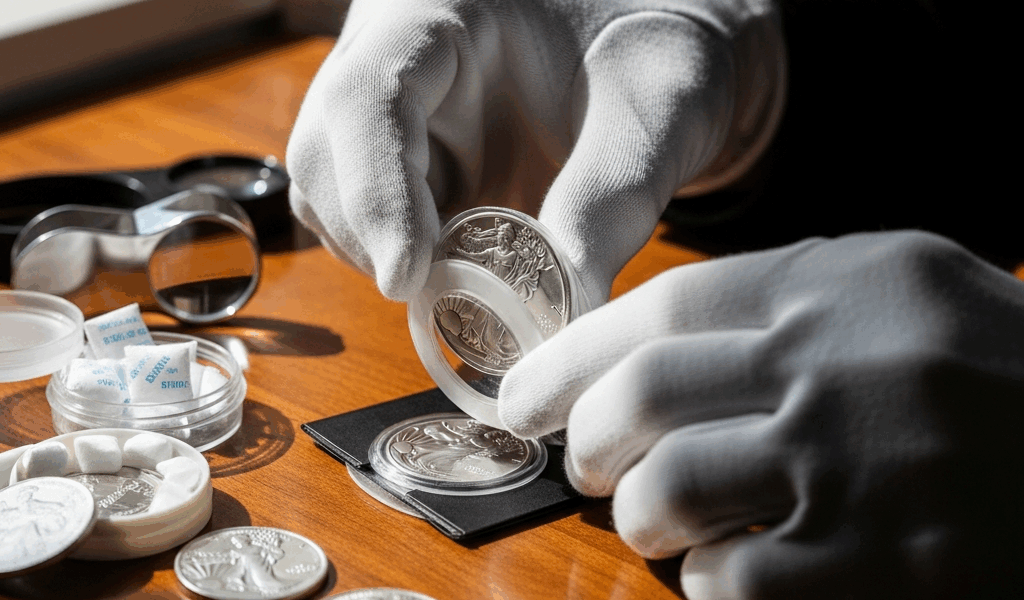
Air-Tite direct-fit capsules might be the best option for individual display coins, as long-term storage requires actual airtight protection. That’s because no airborne compounds can reach the coin surface at all — hard clear plastic rings with a genuine seal. They come calibrated to specific coin diameters. A Morgan dollar takes a 38.1mm capsule. A Silver Eagle takes a 40.6mm. The downside is cost — typically $1.50 to $2.00 per capsule at retail, which adds up fast across a large collection. Use them for display pieces and better-date material.
PVC-free 2×2 Mylar flips are the practical workhorses. Around $8 to $12 for 100 flips depending on brand — inexpensive enough that you can flip the habit, so to speak. They’re not airtight, but in a properly managed storage environment, that limitation rarely matters in practice. These are what I use for circulated type coins and anything I’m actively sorting through or still researching.
NGC and PCGS certified holders — slabs — are the gold standard. Hermetically sealed, tamper-evident, graded by independent experts whose opinion the market actually prices off of. For any coin worth $100 or more, NGC or PCGS submission is genuinely worth the fee. The holder itself provides meaningful protection. The grade provides documentation. Together they provide liquidity when it eventually comes time to sell.
Environment — The Temperature and Humidity Rules
Probably should have opened with this section, honestly. Because you can use perfect holders and still ruin coins if you’re storing them in the wrong place.
Silver tones faster when it’s warm, when it’s humid, when sulfur compounds are floating around in the air. Basements and garages typically check all three boxes. Wool rugs, rubber bands, certain latex paints, ordinary cardboard boxes — all of these off-gas sulfur compounds that accelerate toning on silver surfaces. A single rubber band sitting against a silver coin will leave a permanent dark contact mark within months. I watched this happen to a Walking Liberty half once. Not great.
The target environment is straightforward enough: 40 to 50 percent relative humidity, 65 to 70 degrees Fahrenheit, clean air. Silica gel desiccant packets in your storage boxes handle the humidity side — the standard color-indicating packets that shift from blue to pink as they absorb moisture work fine and are rechargeable in a low oven. A $15 digital hygrometer from Amazon sitting inside your storage cabinet will tell you whether you’re actually hitting those numbers or just assuming you are.
Safe deposit boxes at banks deserve more credit than they usually get in coin storage discussions. Bank environments are consistently climate-controlled, free of sulfur compounds, and offer physical security that no home cabinet can realistically match. For your most valuable coins — anything you’d genuinely be upset to lose — a safe deposit box at a modest annual fee is worth serious consideration.
Toning — Natural vs Artificial vs Damage
Not all toning is damage. Getting this wrong in either direction costs real money — that’s what makes the distinction so endearing to us collectors who’ve learned it the hard way.
Original toning on Morgan dollars — the rainbow iridescence that develops over decades in original Mint bags, or the cartwheel colors that form from contact with paper and fabric — is actively sought by collectors. A naturally toned Morgan with rich reds, blues, and golds in the right pattern can command a significant premium over a blast-white example of the same date and grade. NGC and PCGS both recognize original toning in their grading standards, apparently to the surprise of people new to the hobby.
Artificially toned coins are a different matter entirely. Experienced eyes recognize the difference immediately. Artificial toning tends to sit on the coin’s surface in a way that reads as applied. Natural toning integrates with the luster — different color distributions, different depth. Dealers who handle volume see artificial toning constantly, and a coin identified as such loses most of its premium instantly.
The practical rule: black toning obscuring design detail is damage. Gray or brown even toning that still allows full detail visibility is typically original patina. Do not attempt to remove any toning without consulting a professional numismatist first — cleaning, even with seemingly gentle methods, destroys luster in ways that are immediately visible under magnification. A cleaned coin grades as Details at PCGS or NGC and sells at a steep discount. The toning you’re trying to fix is almost always less damaging than the cleaning you’d use to fix it.
Organizing a Silver Coin Collection — The Practical System
Frustrated by watching disorganized collections sell at fractions of their actual value at estate auctions — I’ve seen this happen more than once at shows in the Midwest — I built a system simple enough to actually maintain long-term.
For the working collection — circulated coins, type coins, anything under $50 — PVC-free 2×2 flips stored in Lighthouse or BCWS brand binder pages, sorted by series and date. These pages hold 20 flips each and fit standard three-ring binders. Label each flip with acquisition date, purchase price, and source. Pencil notation on the cardboard flap is perfectly fine.
Display coins and better-date pieces go into Air-Tite capsules in a wooden coin cabinet. Knox and Guardhouse both make decent options in the $40 to $80 range. Keep them away from exterior walls — temperature swings from outside air do real damage over time.
Key dates and anything worth $100 or more should be in PCGS or NGC slabs. Full stop.
Documentation matters separately from the physical collection itself. Photograph every significant coin — both sides, decent light — and keep those images in a cloud folder or on a backup drive stored somewhere other than where the coins are. A simple spreadsheet tracking coin, date, grade, purchase price, and estimated current value takes maybe 20 minutes to set up and saves enormous headaches later. Ask anyone who’s had to settle an estate without one.
One final point that most storage guides skip entirely: insurance. Standard homeowners policies typically cap coin coverage at $200 to $500 total — regardless of what the collection is actually worth. A numismatic floater policy through companies like Hugh Wood or American Collectors Insurance is necessary for any collection over $1,000. Premiums are generally low relative to coverage. Get quotes before you need them, not after.

Stay in the loop
Get the latest numisma master updates delivered to your inbox.