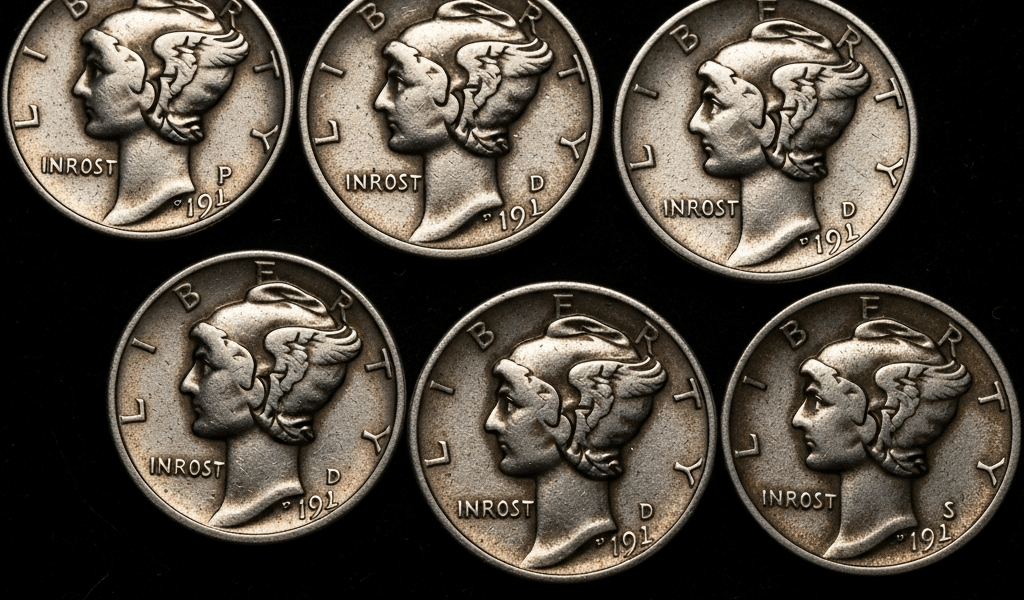
What Mercury Dimes Are and Why Collectors Love Them
Mercury dime collecting has gotten complicated with all the misinformation flying around. So let me clear something up before we go any further: these coins have nothing to do with the Roman god Mercury. Not even close. Adolph Weinman designed the reverse with a fasces — a bundled rod symbol representing strength — and added wings to it. People saw wings and assumed Mercury’s winged hat. The name stuck anyway. That’s just how coin nicknames work.
But what is a Mercury dime, really? In essence, it’s a 90% silver ten-cent piece struck between 1916 and 1945. But it’s much more than that. These are arguably the most artistically interesting coins the U.S. Mint produced in the 20th century, and the market reflects it. A heavily worn example in Good condition trades somewhere between $1.50 and $3 on a slow day. Nicer pieces — think Fine to XF — fetch $10 to $50 depending on which year and which mint stamped it. Then there are the problem dates. The 1916-D and 1921-D command hundreds or thousands even when they’re beat to death. That’s why I put together a full breakdown by year and mint mark. The gap between a $15 dime and an $800 dime comes down to knowing exactly which combinations matter. Today, I will share it all with you.
Key Dates and Mint Marks That Drive Real Value
The 1916-D — The King of Mercury Dimes
Frustrated by a tight production window and limited Denver Mint capacity, Weinman’s design rolled out in 1916 with just 264,000 dimes struck at the D mint — using the same aging equipment that had punched out other denominations all year. Most of those coins got spent immediately. That was 1916. Almost nothing survived in collectible shape.
Good condition specimens sell for $700 to $1,100 today. Fine examples hit $1,500 to $2,200 without blinking. I’ve watched auction results where problem-free Fine 1916-D dimes broke $2,500 — and the bidding wasn’t even dramatic. It just got there. The mint mark sits below the date on the obverse; small, but unmistakable once you’ve seen it. If you think you own one, get it authenticated by PCGS or NGC immediately. Counterfeits exist and they’re good enough to fool casual eyes.
The 1921 and 1921-D
Both the Philadelphia and Denver 1921 dimes are genuinely scarce — and collectors know it. The Philadelphia 1921 runs $8 to $15 in Good, jumping to $25 to $45 in Fine. Not earth-shattering. The 1921-D is the tougher coin. Good condition examples command $60 to $120. Fine lands between $150 and $280. Production had stopped entirely for two years before 1921, which means survivors across both mints are thinner on the ground than the mintage numbers suggest. That’s what makes these endearing to us collectors — the story behind the gap matters as much as the rarity itself.
The 1942/41 Overdate Error
Someone at the Mint grabbed the wrong die in 1942 — an old 1941 hub — and kept striking. Nobody caught it fast enough. The result is a genuine overdate error where the “1” bleeds through underneath the “2” in the date. You’ll need a loupe to spot it, minimum 10x magnification, good lighting, patience. In Fine, these run $30 to $60. In XF, expect $80 to $150. PCGS and NGC have certified thousands of them — the error is well-documented, which actually keeps certification costs reasonable. Unusual for error coins, honestly.
The 1916 Philadelphia — Often Overlooked
Here’s one that gets ignored constantly: the 1916 no-mint-mark Philadelphia dime. Mintage was 22.2 million, which sounds comfortable until you realize how few survived in uncirculated shape. In Good, you’re at $4 to $8. Fine bumps it to $12 to $25. Savvy collectors understand that “no mint mark” doesn’t mean “no value” — this one’s legitimately hard to find clean. Don’t make my mistake of passing it over because it looks ordinary in the album.
Mercury Dime Value Chart by Year and Mint Mark
Use this table to cross-check what you’ve got. Prices reflect PCGS Price Guide data as of January 2024. Values shift with silver spot and market demand, but these ranges hold steady for problem-free, uncleaned coins. So, without further ado, let’s dive in.
| Year | Philadelphia (No Mark) | Denver (D) | San Francisco (S) | Notes |
|---|---|---|---|---|
| 1916 | Good $5 | MS63 $180 | KEY DATE: Good $750 | MS63 $2,500 | Good $8 | MS63 $220 | 1916-D is the rarest date in the series. |
| 1921 | KEY DATE: Good $10 | MS63 $280 | KEY DATE: Good $80 | MS63 $850 | Good $7 | MS63 $180 | Two-year production gap; both P and D are tough. |
| 1931-S | Good $3 | MS63 $120 | Good $4 | MS63 $140 | KEY DATE: Good $40 | MS63 $420 | Scarcest San Francisco date in the run. |
| 1942 | Good $2 | MS63 $80 | Good $2.50 | MS63 $90 | Good $2 | MS63 $85 | Normal date. Common across all grades. |
| 1942/41 | Fine $35 | XF $120 | Fine $40 | XF $140 | Fine $38 | XF $130 | Overdate error. Examine under loupe. |
| 1945 | Good $2 | MS63 $75 | Good $2 | MS63 $80 | Good $2 | MS63 $80 | Final year of the series. Common. |
This is an abbreviated snapshot. A complete reference covers all 30 years across three mints — 90 date-mint combinations total. Bookmark this page for quick lookups at coin shows, estate sales, or whenever a dealer quotes you something that feels off.
What Full Bands Means and Why It Changes the Price
Probably should have opened with this section, honestly. Full Bands — abbreviated FB — is the single biggest condition modifier in Mercury dimes beyond standard grade.
The fasces bundle on the reverse has horizontal lines running across it. Those lines are called bands. On coins struck with proper die pressure and minimal subsequent wear, the bands separate cleanly and hold their edges. On most examples — even uncirculated ones sitting in original rolls — the bands are soft, merged, or just mushy. PCGS and NGC both recognize FB as a special designation, and the premium it commands is not subtle.
A common 1935 in MS65 might trade for around $200. The same coin with Full Bands — MS65 FB — sells for $600 to $900. That’s a 3x to 5x jump on an otherwise ordinary date. I’m apparently someone who thought they could eyeball this, and a standard jeweler’s loupe with inconsistent lighting never cuts it. I bought three raw Mercury dimes claiming FB quality before I understood what I was actually looking at. Don’t make my mistake. The difference between “nice bands” and genuine Full Bands requires trained eyes and a consistent light source — not just enthusiasm and a $12 loupe from Amazon.
Here’s the hard truth: if your Mercury dime estimates above $300, send it to PCGS or NGC before you sell. Raw coins claimed as FB get oversold constantly. Certification protects you either way.
How Condition and Cleaning Affect What Your Dime Is Worth
Grading follows the standard ANA scale — Good means heavy wear with all major design details still readable but flattened. Fine shows moderate wear; Liberty’s wing detail stays relatively sharp. Extremely Fine, or XF, carries light wear and most original luster. Uncirculated means no circulation wear, though bag marks from Mint storage are completely normal and expected.
Cleaning is the fastest way to kill value. Full stop. A cleaned XF Mercury dime drops to Fine or Good pricing regardless of what it looked like before someone went at it with a polishing cloth. Run a 10x loupe across the fields — hairlines are the giveaway. Unnatural reflectivity is the other red flag, that strange mirror look that doesn’t match the coin’s age. A problem-free Fine coin outperforms a cleaned XF every single time at auction.
While you won’t need a full numismatic library, you will need a handful of reliable resources — at least if you’re buying anything over $50. Professional certification might be the best option, as Mercury dime collecting requires absolute confidence in authenticity and grade. That is because the key date counterfeits and overgraded sliders eat into returns fast enough to wipe out a year of casual collecting. Certification fees run $20 to $50 per coin through PCGS or NGC. For anything estimated above $100, that fee is trivial insurance.

Stay in the loop
Get the latest numisma master updates delivered to your inbox.