How to Spot a Counterfeit Morgan Silver Dollar
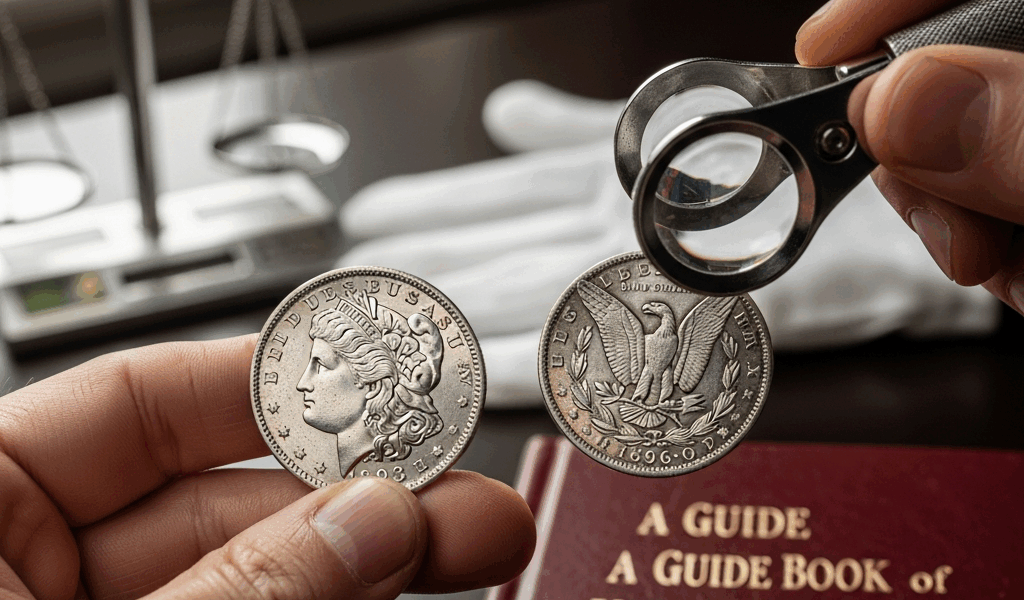
Learning how to spot a counterfeit Morgan silver dollar is one of the most practical skills any coin collector can develop — and I say that as someone who bought a fake 1881-S at a coin show in Columbus about eight years ago and didn’t realize it until I got home and put a scale under it. Twenty-two grams. A genuine Morgan should weigh 26.73 grams. I’d paid $65 for a silver-plated chunk of zinc. That loss stings less now, but the lesson stuck permanently. Morgan dollars are the single most counterfeited coin in the American secondary market, and the fakes have gotten genuinely impressive over the past decade. This guide covers every practical test I know, from basic weight checks to mintmark analysis to slab verification.
Why Morgan Dollars Are the Most Counterfeited US Coin
The counterfeiting economics are simple. A common-date Morgan dollar in circulated condition sells for $25 to $35. A key-date like an 1893-S in Fine condition sells for $500,000 or more at auction. Even mid-range semi-key dates — an 1889-CC, an 1893-O — routinely bring $1,000 to $10,000 depending on grade. That price range, combined with mass market familiarity (everyone has seen a Morgan dollar, or thinks they have), makes this coin the perfect target.
The United States Mint produced over 500 million Morgan dollars between 1878 and 1921. Five mint facilities struck them. The combination of multiple mint marks, multiple dates, and wildly different survival rates between issues means that the same coin design exists in versions worth $30 and versions worth $300,000. Counterfeiters exploit that by altering dates and mintmarks on genuine low-value coins, or by producing outright fakes of the most desirable issues.
Modern counterfeits primarily originate from manufacturing operations in China, specifically in and around Shenzhen. These aren’t crude cast fakes. They’re die-struck, correctly sized, and sometimes silver-plated. A casual inspection won’t catch them. You need a systematic approach.
The Weight and Diameter Test — First Gate
Start here. Every time. No exceptions.
A genuine Morgan dollar weighs exactly 26.73 grams with a composition of 90% silver and 10% copper. The diameter is 38.1mm. The edge carries 189 reeds. Those three numbers are your baseline. Any coin claiming to be a Morgan dollar gets measured against them before anything else.
For weighing, I use an AWS-100 digital pocket scale that cost me $12 on Amazon. It’s accurate to 0.1 grams. Cheap base-metal fakes — the ones that fool nobody at a coin show but circulate at flea markets and estate sales — typically weigh between 20 and 23 grams. They fail immediately. The more dangerous tier of fake, the die-struck silver-plated variety, often comes in between 26.1 and 26.9 grams. Still wrong. Silver has a density of 10.49 g/cm³. A coin made of a lighter base metal and plated in silver won’t match that density profile even if the manufacturer tries to compensate with thickness.
Measure the diameter with a digital caliper — the Neiko 01407A is a decent sub-$20 option. Anything outside 37.9mm to 38.3mm is suspicious. Reeding is harder to count manually, but if the edge looks sparse or uneven under a loupe, that’s a flag worth noting.
The Ring Test
Drop the coin onto a hard surface — I use a granite countertop — from about six inches. A genuine silver coin produces a clear, sustained high-pitched ring. The sound lingers. Base metal coins or heavily plated coins produce a flat thud or a short dull tone with no sustain. It’s not a definitive authentication tool on its own, but combined with weight and diameter, a coin that fails the ring test has very little going for it. Probably should have mentioned the ring test first, honestly — it’s the fastest gut-check you have before reaching for the scale.
The Specific Die Characteristics of Genuine Morgan Dollars
Passed the weight and diameter check? Good. Now look at the coin itself.
Genuine Morgan dollars have specific die characteristics that take real effort to replicate. Most counterfeiters don’t get them right. Here’s where to look with a 10x loupe, which should be in every collector’s kit. The Bausch & Lomb Hastings Triplet 10X is what I carry — about $35 and worth every cent.
Liberty’s hair above the ear: On a genuine Morgan, the hair strands above Liberty’s ear show fine, parallel lines with clear individual definition. Even on circulated examples, you can see where individual strands separate. On most counterfeits, that area is blurred. The lines merge into a soft, rounded texture. It looks like someone drew hair rather than engraved it.
The LIBERTY headband: The lettering on Liberty’s headband should be sharp-edged with crisp serifs. On fakes, the letters are often slightly rounded at the edges or show a soft halo effect where the metal transitions from device to field.
Eagle feather definition on the reverse: The eagle’s breast feathers should show layered, distinct separation. Run your loupe slowly across the center breast area. Genuine coins show feather over feather with clear boundaries. Counterfeits flatten this into a textured blob.
The most frequently counterfeited dates are the 1893-S, 1889-CC, 1895 (proof only — no business strike 1895 Philadelphia Morgan exists), and the 1879-CC. If someone is selling any of these at a price that seems reasonable, treat it as a fake until proven otherwise. No exceptions. An 1895 Philadelphia Morgan in any circulated grade is impossible — the only genuine examples are proofs, and they don’t show wear.
Modern Chinese Counterfeits — What They Get Wrong
Burned by that fake 1881-S years ago, I’ve spent a lot of time studying exactly what the current generation of Chinese-manufactured fakes gets wrong. The answer is: more than you’d expect, once you know what to look for.
The most revealing flaw is luster. Genuine Morgan dollars, even heavily circulated ones, show a specific reflective quality called cartwheel luster. Hold the coin under a single light source and rotate it slowly. On a genuine coin, you’ll see a rotating sweep of reflected light that moves across the coin’s surface like spokes on a wheel. This effect is created by the flow lines in the metal from the striking process. Counterfeits cannot replicate it. The surface either reflects uniformly (dead, flat light) or shows irregular patches. That absence of cartwheel luster is the single most reliable visual tell on a die-struck fake.
The second major flaw is mintmark execution. Counterfeiters producing fake key dates often use the wrong mintmark punch style or place the mintmark in the wrong location relative to the wreath bow on the reverse. The 1893-S is a prime example. On a genuine 1893-S, the S mintmark has specific characteristics — a particular serif style, a particular lean, a particular position. Most 1893-S fakes I’ve examined use a mintmark that’s either too large, too upright, or shows the wrong serif form for that era’s San Francisco punch.
- Wrong mintmark size relative to coin diameter
- Incorrect mintmark placement — too high, too low, or tilted differently than genuine examples
- Mintmark style inconsistent with the mint facility’s actual punches for that year
- Mintmark that shows signs of being added to a different genuine coin (look for disturbance in the field around the mintmark base)
Altered-date coins deserve their own mention here. Some counterfeiters take genuine low-value Morgans and alter the date or mintmark to create a more valuable issue. On these, the rest of the coin is genuine — it will weigh correctly, ring correctly, and show genuine luster. The only tell is the altered area itself. Look for tooling marks, a mismatched surface texture around the altered digits, or a date numeral that sits at a different depth than the surrounding design elements. High-magnification examination under raking light catches these.
The PCGS and NGC Certification Check — Authenticating a Slabbed Coin
A Morgan dollar in a Professional Coin Grading Service (PCGS) or Numismatic Guaranty Company (NGC) slab carries an implied authentication. Both services physically examine coins before grading them, and both maintain online registries. If you’re buying a slabbed Morgan — which you should be doing for any purchase over $200, frankly — verification is a two-step process.
First, look up the certification number. PCGS offers free certificate verification at pcgs.com/cert. NGC offers the same at ngccoin.com/certlookup. Type in the number printed on the label. The registry will return the coin’s description, grade, and date of certification. If that number returns no result, the slab is fake. Full stop. The coin inside might be genuine or it might not be — but the slab has been counterfeited, and you have no authentication.
Second, examine the slab itself.
- Genuine PCGS slabs carry a hologram security sticker and microprinting on the label that is not reproducible with standard printing equipment
- Genuine NGC slabs have a distinctive edge treatment — a specific pattern around the slab perimeter that fake slabs frequently get wrong in thickness or uniformity
- Both slab types should have no seams, no bubbling, no stress marks in the plastic — signs of the slab having been opened and resealed
- The label font, spacing, and color saturation on counterfeit slabs often differ subtly from genuine examples — compare against a known genuine slab if possible
Struck by the number of counterfeit slabs appearing on resale platforms in 2021, both PCGS and NGC updated their security features, so older documentation about slab authentication may be partially outdated. Check both services’ current websites for their latest security feature descriptions before relying on older guides.
One last thing. For any Morgan dollar purchase over $500, get a second opinion from a dealer who is a member of the American Numismatic Association. The ANA membership implies adherence to a code of ethics and a level of professional knowledge. A ten-minute in-person examination by an experienced dealer catches things that even careful self-examination misses. The fee for that consultation — usually nothing if you’re buying from them, or a small flat fee otherwise — is cheap insurance against a very expensive mistake.
The fake I bought in Columbus taught me the weight test. Everything since has been refinement. Know your numbers, know your surfaces, verify your slabs.

Stay in the loop
Get the latest numisma master updates delivered to your inbox.