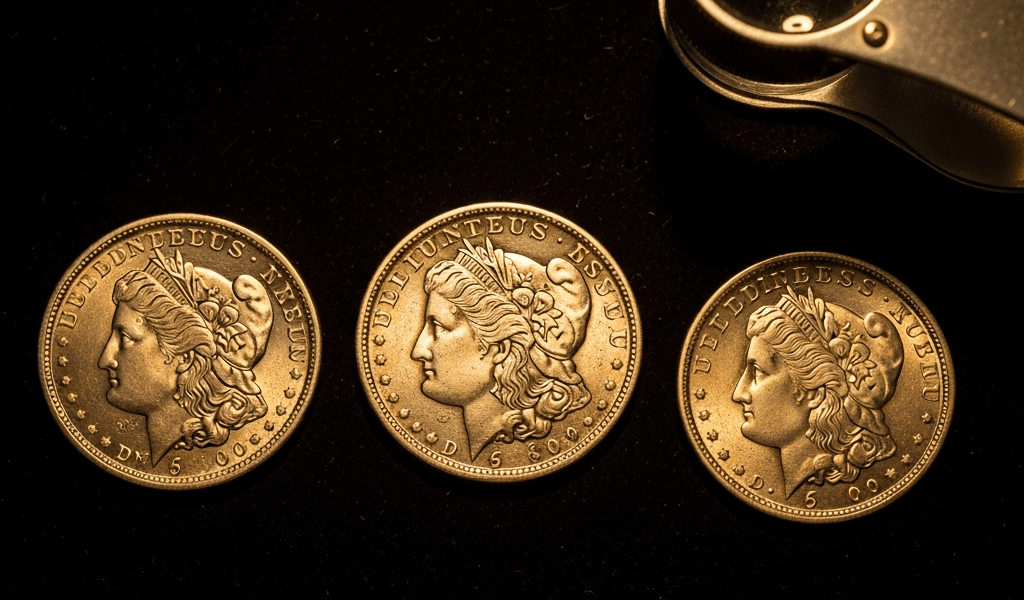
Why Two Morgan Dollars Can Be Worth Very Different Amounts
Morgan dollar collecting has gotten complicated with all the misinformation flying around — especially online, where every 1921-D suddenly becomes a “rare find” and every toned coin gets called “original surfaces” regardless of what actually happened to it. As someone who spent two years buried in auction archives, population reports, and a embarrassing number of regrettable purchases, I learned everything there is to know about what actually drives Morgan dollar value. Today, I will share it all with you.
It started at a show in Tulsa. I held two Morgans side by side — both dated 1884, both the same silver content, obviously. One was stickered at $38. The other at $420. They looked almost identical to me at the time. Almost. That single moment of confusion sent me down a rabbit hole I’m honestly still crawling out of. What I eventually figured out is that Morgan value breaks down into four concrete factors: date and mintmark, strike quality, surface preservation, and eye appeal. Run any coin through those four checkpoints and you’ll have a realistic read on it before you ever crack a price guide.
Date and Mintmark — The First Thing to Check
But what is a mintmark, exactly? In essence, it’s a small letter stamped onto the coin identifying which facility produced it. But it’s much more than that — it’s often the single biggest variable separating a $35 coin from a $5,000 one.
Flip the coin to the reverse. Look at the bottom of the eagle, just above the D-O in DOLLAR. No letter means Philadelphia. An S means San Francisco. CC means Carson City. O means New Orleans. D means Denver. Simple enough. The complication is that mintage numbers swung wildly across those facilities depending on the year.
The 1893-S is the key date most collectors know by name. Fewer than 100,000 were struck. Survivorship in decent grades is brutal. A circulated example in Very Fine condition — clear design elements, obvious wear on the high points — regularly sells for $5,000 to $10,000. The 1895 Philadelphia issue is proof-only. Essentially out of reach for most people at $50,000 and up. Don’t make my mistake of assuming a Philadelphia coin is automatically less interesting than a branch mint piece. That year, it’s the only option.
Then there are the workhorses. High-mintage dates that dominate coin shows and estate sales in equal measure.
- 1921-D and 1921-P — tens of millions struck, extremely common
- 1884-O — heavily hoarded in Treasury bags, survivors are plentiful
- 1896-P — common in circulated grades
- 1900-O — abundant, especially in lower mint state grades
- 1881-S — extremely common in high mint state, but genuinely beautiful for it
Common doesn’t mean worthless. It means you’re paying for the silver and the coin — not rarity. A 1921-D in average circulated condition tops out around $25 to $35. Fine for a type collection. Painful if you handed over $90 thinking that D mintmark made it something special. I’ve seen it happen at every show I’ve attended.
Strike Quality and Surface Preservation
Probably should have opened with this section, honestly. New collectors skip straight to the date and then wonder why their “MS64” looks worse than somebody else’s coin at the same grade. That’s almost always a strike problem.
Strike quality is how fully the dies impressed the design into the planchet at the moment of minting. The two spots that reveal it fastest on a Morgan: Liberty’s hair directly above her ear and the eagle’s breast feathers on the reverse. On a sharply struck coin, those hair strands are distinct — almost individually traceable under a 5x loupe. On a weakly struck coin, that same area goes mushy and flat, like someone pressed a thumb into wet clay before it dried. Whole mintages are known for this problem. New Orleans issues, I’m apparently wired to avoid them instinctively now, and avoiding weak-strike O-mint coins works for me while chasing high-grade examples has never worked out the way I hoped.
Weak strike is not the same as wear. This distinction is where grading terminology actually earns its keep. Three terms worth having in your vocabulary:
- MS (Mint State) — the coin never circulated; no wear on the high points whatsoever
- AU (About Uncirculated) — slight wear on the cheekbone and eagle’s breast, coin looks nearly new
- VF (Very Fine) — moderate wear, all major design features clear, some detail lost in hair and feathers
Contact marks are a separate issue entirely. Those are small nicks and abrasions from coins rattling against each other in mint bags — not wear from circulation. An MS coin can be covered in them. Still technically uncirculated, but cosmetically rough. The numerical grades MS60 through MS70 largely measure the absence of those marks alongside strike sharpness. An MS63 with a sharp strike looks dramatically better than an MS63 with a weak strike and bag marks dragged across Liberty’s cheek. Same number. Very different coin.
Luster, Toning, and Eye Appeal — The Factors That Surprise Collectors
Here is where the real money lives. Also where I made my most expensive early mistakes — plural, unfortunately.
Original cartwheel luster is that spinning, almost liquid-looking reflectivity you get when you rotate a mint state Morgan under a single light source. The light seems to sweep across the coin in waves. It comes from flow lines in the metal left by the striking process, and it is genuinely fragile. Once it’s gone, it doesn’t come back.
Dipping — cleaning a coin in a mild acid solution, usually a product called E-Z-Est that runs about $8 a bottle — removes toning but also strips luster. A dipped coin looks bright and white but flat. Experienced dealers spot it immediately. That’s what I should have recognized at that Tulsa show back in 2019. Dipped Morgans trade at a discount even when technically problem-free by grading standards. A heavily dipped coin can lose 30 to 50 percent of its market value versus an original-surface example at the same numerical grade. That’s not a small haircut.
Toning is where collectors disagree most passionately — and loudly, at shows especially. Natural toning develops over decades as silver reacts with sulfur compounds in the air or in old paper coin envelopes. It can be extraordinary: deep iridescent rings of gold, rose, violet, and steel blue that look like a frozen oil slick. Or it can be ugly — dark gray, patchy, brown-black blotches that kill detail and market value in equal measure. Artificial toning, chemically induced to mimic the real thing, tends to look flat and concentrated. Too vivid. Dealers hold the coin at a sharp angle and look for depth. Authentic toning sits differently in the fields versus on the devices. Chemical treatment usually doesn’t respect that distinction.
Two coins graded MS64 by PCGS can go to auction and realize $180 and $650 respectively. The difference is almost always eye appeal — luster quality, toning character, strike. The grade is a floor. Not a ceiling. That’s what makes Morgan dollars endearing to us collectors: the number on the label is just the starting point.
How to Use These Factors When Buying or Selling
So, without further ado, let’s dive in — specifically into the four-step check I now run at every table, using nothing but decent lighting and a $15 loupe from Amazon.
- Read the date and mintmark — identify key date, semi-key, or common date immediately before anything else
- Check Liberty’s hair above the ear and the eagle’s breast feathers — assess strike sharpness first
- Look for wear on the cheekbone and eagle’s breast under magnification — confirm circulated versus mint state
- Rotate the coin under a single light source — watch for cartwheel luster, assess toning honestly and skeptically
For rarity context, PCGS and NGC both publish population reports — searchable databases showing how many coins of a given date, mintmark, and grade they’ve certified. If PCGS has certified 4,200 examples of a particular coin in MS64, it is not rare at that grade regardless of what a dealer’s pitch sounds like. If they’ve certified 11, you are holding something categorically different. Those reports are free to search. Use them.
While you won’t need a professional numismatist on speed dial for every purchase, you will need a handful of basic resources — a loupe, access to the PCGS or NGC price guide, and a few minutes with the population data before committing real money. First, you should cross-reference any coin against its population numbers — at least if you’re spending more than $100. A certified third-party holder might be the best option, as Morgan investing requires confidence in what you’re actually holding. That is because the difference between an original-surface MS63 and a dipped, problem-free MS63 is invisible to most buyers but very visible in the final sale price.
Most Morgans you encounter at shows, in estate lots, or in old collections are common-date circulated coins. That is not a flaw. A lightly circulated 1884-O with original surfaces and honest wear is a beautiful piece of American monetary history at a price nearly anyone can afford. Understanding the value framework just means you pay the right price for what it actually is — and occasionally recognize when something genuinely special is sitting in a $40 bin. That moment hasn’t gotten old yet.

Stay in the loop
Get the latest numisma master updates delivered to your inbox.